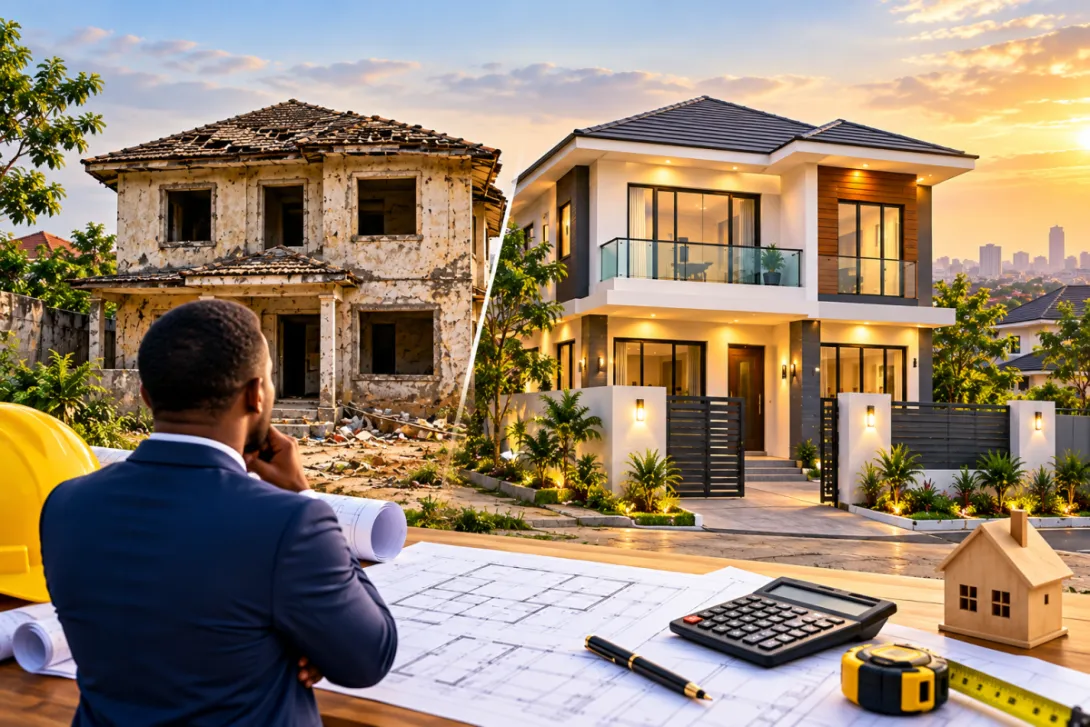
Buying Cheap and Renovating Is Not Always a Good Deal
You find an old house in a promising location.
The seller is asking ₦80 million.
You estimate that another ₦30 million will transform it into a beautiful modern home.
You spend the money.
The property now looks fantastic.
Then you put it on the market for ₦150 million.
And nothing happens.
Weeks become months.
You reduce the price.
Still, there are no serious buyers.
Eventually, you discover the problem:
The market does not value the property at ₦150 million.
This is one of the biggest risks in house flipping in Nigeria.
The mistake is thinking:
Purchase price + renovation cost = selling price.
Unfortunately, the property market does not work that way.
What you spend on a property does not automatically determine what someone else is willing to pay for it.
Before you buy a property to renovate and sell, you need to understand the market you are buying into.
What Is House Flipping?
House flipping is the process of buying a property, improving or renovating it and reselling it at a higher price with the aim of making a profit.
The strategy sounds simple:
Buy → Renovate → Sell → Profit.
But the real equation is more complicated.
Your actual investment may include:
- Purchase price
- Legal and documentation costs
- Agency fees
- Taxes and statutory charges where applicable
- Renovation costs
- Professional fees
- Construction materials
- Labour
- Financing costs
- Security
- Maintenance
- Utilities
- Marketing
- Selling expenses
- Holding costs while waiting for a buyer
And there is one more important number:
What the market is actually willing to pay.
That number should influence your decision before you spend your first naira on renovation.
The Biggest Question: What Will the Property Be Worth When You Finish?
Before buying a property for a flip, don't start with:
"How beautiful can I make this house?"
Start with:
"How much can I realistically sell this property for when I am finished?"
That changes the entire investment calculation.
Suppose you believe a renovated property can sell for ₦150 million.
Your total project cost should not simply be allowed to rise until it reaches ₦150 million.
You need enough room for profit and unexpected expenses.
For example:
Expected selling price: ₦150 million
Purchase price: ₦85 million
Renovation: ₦25 million
Professional/legal/transaction costs: ₦7 million
Holding and marketing costs: ₦5 million
Total estimated cost: ₦122 million
Your projected gross margin is therefore approximately ₦28 million before considering other possible costs and taxes.
But what happens if buyers in that location are only willing to pay ₦135 million?
Your projected margin falls dramatically.
And what happens if renovation costs increase from ₦25 million to ₦35 million?
Your numbers become even tighter.
This is why property flipping in Nigeria requires more than construction knowledge. It requires market analysis.
Location Can Make or Break Your Flip
A beautifully renovated house cannot completely overcome a weak location.
Before purchasing, study the neighbourhood carefully.
Ask:
- Who lives in the area?
- Who is currently buying there?
- What type of houses sell fastest?
- What are comparable properties selling for?
- What is the rental demand?
- How accessible is the location?
- What infrastructure exists?
- What developments are coming into the area?
- Are there drainage or flooding concerns?
- Is the area predominantly residential, commercial or mixed-use?
- What type of buyer can realistically afford the finished property?
A developer may see an old property and think:
"I can transform this."
But the more important question is:
"Does this location support the price I need after the transformation?"
That is the difference between renovating a property and investing strategically.
Don't Build What You Like. Build What the Market Wants.
This is another common mistake.
A developer buys an old three-bedroom house and decides to turn it into an extremely luxurious five-bedroom smart home.
Imported fittings.
Designer kitchen.
Expensive tiles.
Large walk-in closets.
Home automation.
Swimming pool.
Landscaped garden.
Everything looks impressive.
But what if the buyers in that neighbourhood are primarily looking for affordable three-bedroom or four-bedroom homes?
The renovation may have made the property more expensive without making it more desirable to the actual market.
Luxury is not automatically value.
The right renovation is one that improves the property's appeal without pushing its price beyond what the market can support.
Understand the Type of House That Sells in the Location
Before you renovate, study the prevailing property types.
For example, a particular neighbourhood may have strong demand for:
- Three-bedroom terraces
- Four-bedroom semi-detached houses
- Compact family homes
- Duplexes with boys' quarters
- Apartments
- Serviced apartments
- Luxury detached houses
Another location may have a completely different buyer profile.
If you are buying a property for resale, your renovation strategy should reflect that reality.
Don't assume that because a particular design is popular on Instagram, TikTok or Pinterest, buyers in your target neighbourhood will pay a premium for it.
Build for the buyer, not just for your personal taste.
Calculate the Numbers Before You Buy
One of the most important principles of property flipping is simple:
Do the numbers before you fall in love with the property.
Create a realistic project budget before making an offer.
Your calculation should include:
1. Acquisition Cost
How much will you actually pay to acquire the property?
Don't forget transaction-related expenses.
2. Renovation Cost
Get realistic estimates for:
- Demolition
- Masonry
- Roofing
- Plumbing
- Electrical works
- Windows
- Doors
- Flooring
- Kitchen
- Bathrooms
- Painting
- External works
- Security
- Landscaping
- Other finishing works
3. Professional Costs
Depending on the project, you may need architects, engineers, quantity surveyors, lawyers, contractors and other professionals.
4. Holding Costs
What will it cost you to hold the property while you renovate and search for a buyer?
The longer the project takes, the more expensive it can become.
5. Marketing and Selling Costs
You may need professional photography, marketing, agency services and other selling expenses.
6. Contingency
Renovation projects rarely go exactly according to the original budget.
Unexpected structural problems, material price increases and additional works can quickly increase your costs.
Don't Confuse Renovation Cost With Added Value
This distinction is extremely important.
Suppose you spend ₦10 million upgrading a kitchen.
That does not necessarily mean the property has gained ₦10 million in market value.
You could spend ₦20 million renovating a property and discover that the market only values the improvements at ₦10 million.
This is why developers need to think in terms of return on renovation, not simply renovation quality.
Ask:
Which improvements will buyers actually pay for?
Sometimes repainting, improving the bathrooms, upgrading the kitchen, fixing structural defects and improving the exterior can make a property significantly more attractive.
Other expensive additions may produce little additional resale value.
Study Comparable Properties
Before deciding what your renovated property should sell for, look at comparable properties.
Compare properties with similar:
- Location
- Land size
- Floor area
- Number of bedrooms
- Property type
- Age
- Condition
- Quality of finishing
- Accessibility
- Documentation
- Amenities
Don't compare your renovated property with the most expensive house you can find online.
Look at properties that your potential buyer would genuinely consider as alternatives.
Your competition is not every property in Lagos.
Your competition is the other properties your buyer can choose instead of yours.
Ask Who Your Exit Buyer Will Be
Every property flip needs an exit strategy.
Before buying, identify your likely buyer.
Is it:
- A young professional?
- A growing family?
- An investor?
- An expatriate?
- A corporate tenant looking for accommodation?
- A high-income executive?
- Another developer?
- A first-time homeowner?
Your answer should influence what you buy and how you renovate it.
If you don't know who your buyer is, you may end up creating a property that looks impressive but has a very small market.
A Beautiful Property Can Still Be Overpriced
This is where many property flippers get stuck.
They look at what they spent and say:
"I cannot sell below ₦X. I have already spent too much."
But buyers don't pay you because you spent too much.
They pay based on what they believe the property is worth relative to their alternatives.
That means an expensive renovation can become a problem if it pushes your asking price beyond the neighbourhood's price range.
The market does not reimburse you for poor budgeting.
If you overpay when buying, overspend during renovation and then discover that your location cannot support the final price, your profit can disappear.
Think About Resale Before You Buy
One of the smartest things a developer can do is think like the future buyer.
Before purchasing, ask:
If I needed to sell this property two years from now, who would buy it?
Then ask:
What would make them choose this property over another one?
This forces you to consider:
- Location
- Price
- Accessibility
- Design
- Property size
- Number of rooms
- Parking
- Security
- Infrastructure
- Documentation
- Finishing
- Maintenance costs
- Neighbourhood demand
If you cannot clearly answer those questions, you may not have fully understood the investment yet.
Don't Ignore the Cost of Time
Time is money in property development.
A project that should take six months but takes twelve months can significantly affect your returns.
During that period:
- Your money is tied up.
- Construction costs may rise.
- Financing costs may increase.
- The market may change.
- Your target buyers may shift.
- You may need to spend more on security and maintenance.
- You may eventually be forced to reduce your asking price.
This is why experienced developers don't only ask:
"How much will I make?"
They also ask:
"How long will my money be tied up?"
What If the Market Changes Before You Sell?
This is one of the biggest risks in property flipping.
You may start a project when buyers are paying ₦140 million for similar properties.
By the time you finish, buyers may be negotiating around ₦125 million.
Your construction costs don't automatically fall just because the market has changed.
That is why your initial purchase price matters so much.
The margin you create when you buy gives you protection when the market changes.
If you buy at the wrong price, you may have very little room for error.
A Simple Property Flip Test
Before investing in a renovation project, ask yourself these questions:
Location
Is there genuine demand for property in this location?
Buyer
Who is likely to buy the finished property?
Property Type
Is the type of house appropriate for this market?
Acquisition
Am I buying the property at a price that leaves room for profit?
Renovation
Which improvements will actually increase market appeal?
Resale
What are comparable properties selling for?
Total Cost
Have I included acquisition, renovation, professional, holding and selling costs?
Exit
Can I realistically sell at my projected price?
Margin
Is there enough room for unexpected costs and market changes?
If the numbers only work under perfect conditions, the project may be too risky.
The Goal Is Not to Create the Most Beautiful House
The goal of property flipping is not necessarily to create the most luxurious property.
It is to create a property that is:
desirable, appropriately priced, marketable and profitable.
Sometimes the smartest renovation is not the most expensive one.
It is the one that gives buyers what they actually want while keeping the developer's total cost under control.
That could mean improving the kitchen, modernising the bathrooms, fixing structural defects, improving the façade, repainting, upgrading the electrical and plumbing systems, improving security or creating better outdoor space.
Renovate strategically, not emotionally.
Before You Flip, Know Your Numbers
House flipping can create opportunities for developers and investors, but it is not simply about finding an old house and making it beautiful.
The real work begins before the renovation.
You need to understand:
What are you buying?
Why are you buying it?
Who will buy it from you?
What will they pay?
How much will the entire project cost?
How long will it take?
And most importantly:
What happens if the market doesn't give you the price you expected?
The strongest property flips are usually built on disciplined acquisition, realistic costing, appropriate renovation and a clear understanding of the eventual buyer.
Don't let the excitement of transforming a property make you forget the reason you are investing.
You are not renovating just to create a beautiful house. You are renovating to create a property the market will want to buy.
Invest With Insight
Before you buy a property to renovate and resell, look beyond the potential transformation.
Study the location. Understand the buyer. Compare market prices. Calculate your total cost. Determine your realistic resale value and leave room for unexpected expenses.
At LandMall, we help buyers and investors explore property opportunities with a bigger picture in mind—location, property type, market demand, documentation, accessibility and long-term potential.
Don't just buy a property because you can see what it could become.
Understand what the market is willing to pay for what it becomes.
Buy wisely. Renovate strategically. Sell profitably.
Explore property opportunities with LandMall today.