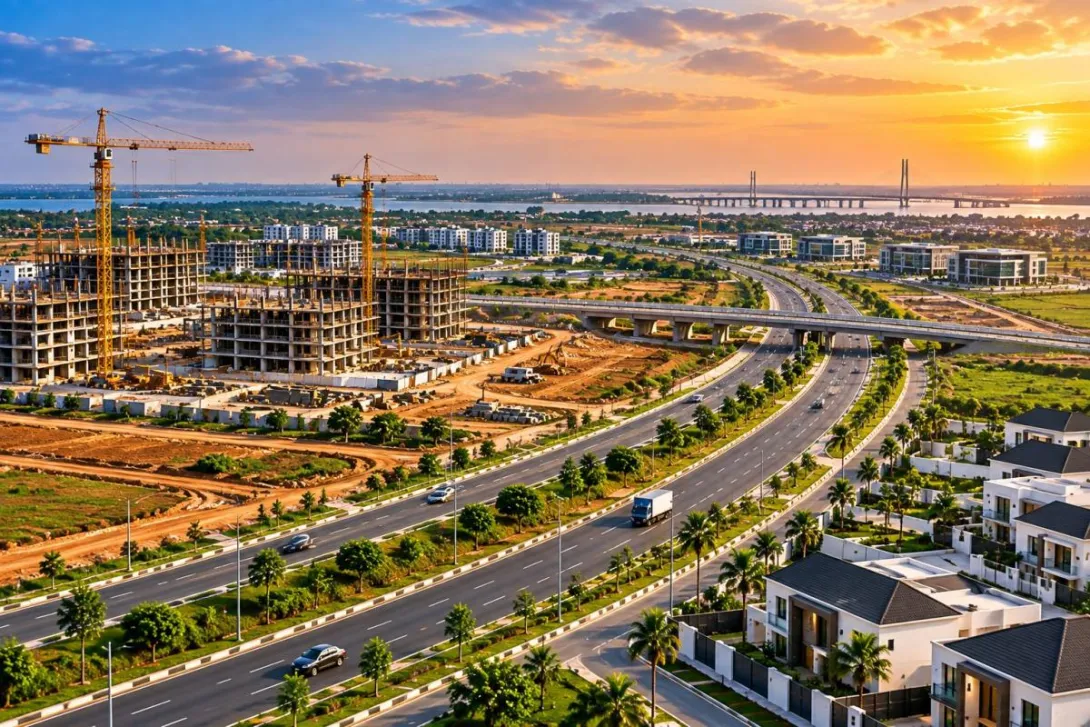
When people are looking at property, they usually focus on the obvious things.
How much is it?
How many bedrooms does it have?
Is the house beautiful?
What is the size of the land?
All important questions.
But there is another question you should ask before you buy:
“What is happening around this property?”
Because a beautiful house in a poorly connected location can become frustrating to live in.
And a modest property in an area experiencing meaningful infrastructure development may become increasingly attractive to buyers, tenants and investors.
That is why infrastructure should be part of your property-buying decision.
Not because every new road automatically makes property prices rise.
Not because every government project will be completed on schedule.
But because infrastructure can influence accessibility, demand, development and ultimately how useful and marketable a property becomes.
In Lagos especially, this matters.
Current market research describes Lagos real estate as increasingly shaped by infrastructure-led appreciation, population pressure and economic development. Along the Lekki-Epe corridor, major projects and economic investments such as the Lagos-Calabar Coastal Highway, Dangote Refinery and Lekki Free Trade Zone are influencing how investors assess the area's future potential.
So before you buy your next property, let's talk about why you should look beyond the property itself.
What Does Infrastructure Mean in Real Estate?
When we talk about infrastructure and property, we're talking about the systems and facilities that make a location accessible, functional and liveable.
That includes things like:
- Roads
- Bridges
- Public transportation
- Drainage
- Electricity
- Water supply
- Telecommunications
- Schools
- Hospitals
- Shopping and commercial centres
- Industrial developments
- Ports and logistics infrastructure
- Rail and water transportation
- Waste management
- Security infrastructure
You don't need every one of these things directly beside your property.
What matters is how the overall infrastructure affects the quality and usefulness of the location.
Think about it this way.
A house is the product.
The surrounding infrastructure helps determine how easy it is to use, reach, develop, rent and eventually sell that product.
1. Good Roads Can Make a Location More Attractive
Let's start with something every Lagos resident understands:
Roads matter.
A property can look fantastic online.
The price can be attractive.
The land can be large.
But if getting there every day is a nightmare, the excitement can disappear very quickly.
Ask yourself:
- How accessible is the property?
- What is the condition of the access road?
- Can you reach it during the rainy season?
- How long does it take to connect to major roads?
- Is the route affected by regular traffic congestion?
- Is the road likely to improve?
Accessibility can affect both residential and investment demand.
If people can get to an area more easily, it can become more attractive to people looking for homes, businesses and investment opportunities.
Nigeria's transport infrastructure remains heavily dependent on roads, while major investments are being made in strategic transport corridors and multimodal connectivity.
That makes accessibility something you should take seriously when evaluating property.
2. Transportation Can Expand Your Property's Market
Here's something many buyers overlook.
People don't necessarily choose where to live based only on where they want to live.
They also think about:
“How do I get to work?”
“How will my children get to school?”
“How easy is it to get around?”
“How long will my daily commute take?”
That's why transportation infrastructure can influence residential demand.
If a location becomes better connected to major employment, commercial or educational centres, it may become more convenient for more people.
And when more people consider an area convenient, demand can potentially increase.
For an investor, that matters.
For a homeowner, it matters too.
3. Infrastructure Can Influence Rental Demand
If you're buying property as an investment, don't just ask:
“What is the property worth?”
Ask:
“Who will want to rent it?”
A rental property needs tenants.
And tenants usually care about convenience.
They may want reasonable access to:
- Work
- Schools
- Markets
- Shopping centres
- Transport
- Healthcare
- Entertainment
- Religious centres
- Major roads
This is why infrastructure can indirectly influence rental demand.
For example, current Lagos market research shows differences in rental yields and appreciation across submarkets, with some growth corridors and mainland locations showing stronger income characteristics than premium areas.
So if you're buying a property for rental income, don't only look at the building.
Study the ecosystem around it.
4. Infrastructure Can Attract Development
Have you ever driven through an area that was mostly undeveloped and then returned a few years later to find new estates, shops, schools and businesses everywhere?
That transformation doesn't happen randomly.
Infrastructure can make development more practical.
A new road can improve access.
Improved access can make land more attractive to developers.
Developers can introduce housing.
Housing can attract residents.
Residents create demand for shops, schools, restaurants, healthcare and other services.
And those services can attract even more people.
It can become a cycle of development.
This is one reason infrastructure is closely watched by property investors.
But remember:
Development potential is not the same thing as guaranteed appreciation.
5. Infrastructure Can Affect Property Values
Let's be careful here.
It would be wrong to say:
“A new road means your property price will definitely double.”
Real estate doesn't work that simply.
Property values are influenced by many factors, including:
- Location
- Demand
- Supply
- Title
- Property quality
- Accessibility
- Infrastructure
- Economic activity
- Interest rates
- Construction costs
- Population growth
- Buyer purchasing power
But infrastructure can be one of the factors supporting increased demand and development.
Agusto & Co.'s 2026 Lagos report describes infrastructure-led appreciation as one of the characteristics shaping the city's real estate market. It also reports substantial land-price increases in parts of the Lekki-Epe corridor between Q1 2025 and Q1 2026, while linking the corridor's development to major infrastructure and economic investments.
That doesn't mean every property in the corridor performed the same way.
It means infrastructure is one of the factors investors should understand.
6. Don't Confuse Proposed Infrastructure With Existing Infrastructure
This is extremely important.
You may hear:
“A major road is coming here.”
Or:
“A railway is coming.”
Or:
“The government is planning a new transport route.”
Sounds exciting.
But before you pay a premium because of that promise, investigate.
Ask:
- Has the project actually started?
- What stage is it at?
- Who is responsible for it?
- Is there an approved plan?
- What is the expected timeline?
- Where exactly will it pass?
- How close is the property?
- Could the project be delayed?
- What happens to your investment if the project takes much longer than expected?
Current Lagos market analysis specifically warns investors in growth corridors to assess infrastructure timing and execution risk, not simply assume that planned infrastructure will immediately translate into value.
That's a very important distinction.
Buy based on evidence, not promises.
7. Drainage and Flood Management Matter
This one deserves more attention in Lagos.
A property may be beautifully finished, but if the surrounding area experiences serious flooding, you need to know before you buy.
Look beyond the house.
Inspect:
- The access road
- Drainage channels
- The surrounding streets
- Nearby water bodies
- Estate drainage
- Ground levels
- Evidence of previous flooding
Ask residents what happens during heavy rainfall.
Don't rely only on what you see on a sunny afternoon.
Because when you're buying property, you're not buying for one perfect day.
You're buying for years.
8. Electricity and Water Affect the Real Cost of Living
Infrastructure isn't only about roads.
Electricity and water can significantly influence how much it costs to live in or operate a property.
For a homeowner, poor infrastructure may mean spending more on:
- Generators
- Fuel
- Inverters
- Solar systems
- Water systems
- Boreholes
- Maintenance
For a landlord, these costs can affect the attractiveness and operating economics of the property.
This is particularly important when comparing two properties that appear similarly priced.
One may have better infrastructure and lower operating costs.
The other may require continuous spending just to provide basic services.
The purchase price isn't always the full cost of ownership.
9. Commercial Development Can Change a Neighbourhood
You don't necessarily need a shopping mall at your doorstep.
But the presence of businesses, offices, schools, hospitals and other services can make a location more functional.
Think about what happens when an area starts attracting:
- Supermarkets
- Restaurants
- Schools
- Hospitals
- Offices
- Banks
- Shopping centres
- Hotels
- Industrial facilities
The area can become more self-sufficient.
And people may become more willing to live there because they no longer have to travel far for everyday needs.
For property investors, this can create a larger potential tenant or buyer pool.
10. Infrastructure Can Influence What You Should Buy
Here's where it becomes more interesting.
Infrastructure doesn't only help you decide where to buy.
It can also help you decide what to buy.
For example, if an area is attracting young professionals because of improved transportation and nearby employment opportunities, apartments may make more sense than large family houses.
If an area is experiencing rapid residential development and land demand, land may be more attractive to some long-term investors.
If an established commercial corridor has strong professional demand, smaller apartments or commercial property may have stronger relevance.
So don't simply ask:
“What property should I buy?”
Ask:
“What type of property fits the direction this location is taking?”
11. Investors Should Look at Infrastructure Differently
If you're buying your own home, you may focus heavily on convenience.
If you're investing, you need to think about future demand and marketability.
Ask:
Who is likely to want this property five years from now?
Then look at the infrastructure supporting that future demand.
For example:
If you're targeting rental income
Look at:
- Transport
- Employment centres
- Schools
- Shopping
- Accessibility
- Tenant demographics
If you're targeting capital appreciation
Look at:
- Infrastructure development
- Land scarcity
- New economic activity
- Population growth
- Development corridors
- Future accessibility
If you're buying land
Look at:
- Road access
- Title
- Existing development
- Infrastructure pipeline
- Surrounding land use
- Development restrictions
- Future demand
The strategy should influence what you look for.
12. Don't Ignore the Existing Infrastructure Because of Future Potential
This is another mistake investors make.
They see an undeveloped area and think:
“This is exactly where I should buy before everyone else discovers it.”
Maybe.
But you need to ask:
“What is the cost of waiting?”
If the location has poor roads, limited electricity, weak drainage and little economic activity, you may have to wait several years before the expected development materialises.
That's not necessarily bad.
It simply means you need to understand your investment horizon.
A long-term land investor may be comfortable waiting.
Someone looking for rental income next year may not be.
The right property depends partly on how long you are willing to wait.
13. Infrastructure Alone Doesn't Make a Good Property
This is perhaps the most important warning in this article.
Don't see a new road and immediately buy.
Don't hear about a new railway and transfer your money.
Don't hear that a major company is coming and assume your property will double.
Infrastructure is one piece of the puzzle.
You still need to investigate:
- Title
- Seller
- Price
- Location
- Property condition
- Land use
- Flood risk
- Demand
- Comparable properties
- Development costs
- Taxes and transaction costs
- Resale potential
A property with excellent infrastructure but a defective title is still a problem.
A cheap property beside a future road but with poor access today may still carry significant risk.
A beautiful house in a prime location can still be overpriced.
Look at the whole picture.
A Simple Infrastructure Checklist Before You Buy
Before committing your money to a property, ask yourself these questions:
Location
Is the property in an area people actually want to live or invest in?
Roads
How easy is it to reach the property?
Transportation
What options exist for getting to and from the area?
Drainage
What happens during heavy rainfall?
Electricity
How reliable is the existing power supply?
Water
What is the source of water?
Commercial activity
Are businesses and services developing around the area?
Employment
Are there economic activities or employment centres supporting demand?
Future infrastructure
What major projects are planned?
Evidence
Are those projects actually progressing?
Property demand
Who is likely to buy or rent this property?
Investment timeline
Can you afford to wait if development takes longer than expected?
Documentation
Is the property's title properly verified?
If you cannot answer these questions, you may not know enough yet to make the purchase.
So, Should You Only Buy in Areas With Excellent Infrastructure?
Not necessarily.
If you only buy in fully developed areas, you may pay a premium for the infrastructure that already exists.
That's why some investors deliberately look at developing locations.
They are trying to identify areas where infrastructure and economic activity may support future growth before prices fully reflect that potential.
But that strategy requires more research and usually more patience.
You're accepting more uncertainty in exchange for potentially getting in earlier.
So there is no universal answer.
The better question is:
“How much risk am I willing to take, how long can I hold the property, and what evidence supports the growth I'm expecting?”
The Bottom Line
When you're buying property, don't look only at the property.
Look at the location.
Then look at what is happening around the location.
A road can change accessibility.
Transportation can change commuting patterns.
Commercial activity can create demand.
New infrastructure can attract development.
Improved services can make an area more liveable.
And growing demand can potentially support property values and rental opportunities.
But infrastructure is not a magic formula.
A proposed project is not a completed project.
And a growing location is not automatically a good investment.
Do your research.
Verify the property.
Understand the infrastructure.
Study the demand.
Know your investment timeline.
Then decide.
Because the smartest property buyers don't just ask:
“What am I buying?”
They also ask:
“What is happening around what I'm buying?”
Invest With Insight
Before you buy property, look beyond the walls, the finishing and the price.
Study the roads. Check the accessibility. Understand the infrastructure. Research the development around the location. Then verify the property itself.
At LandMall, we help buyers explore property opportunities with the bigger picture in mind—location, accessibility, infrastructure, demand and long-term potential.
Don't just buy where property is available.
Buy where the opportunity makes sense.
Research the location. Understand the infrastructure. Invest with confidence.