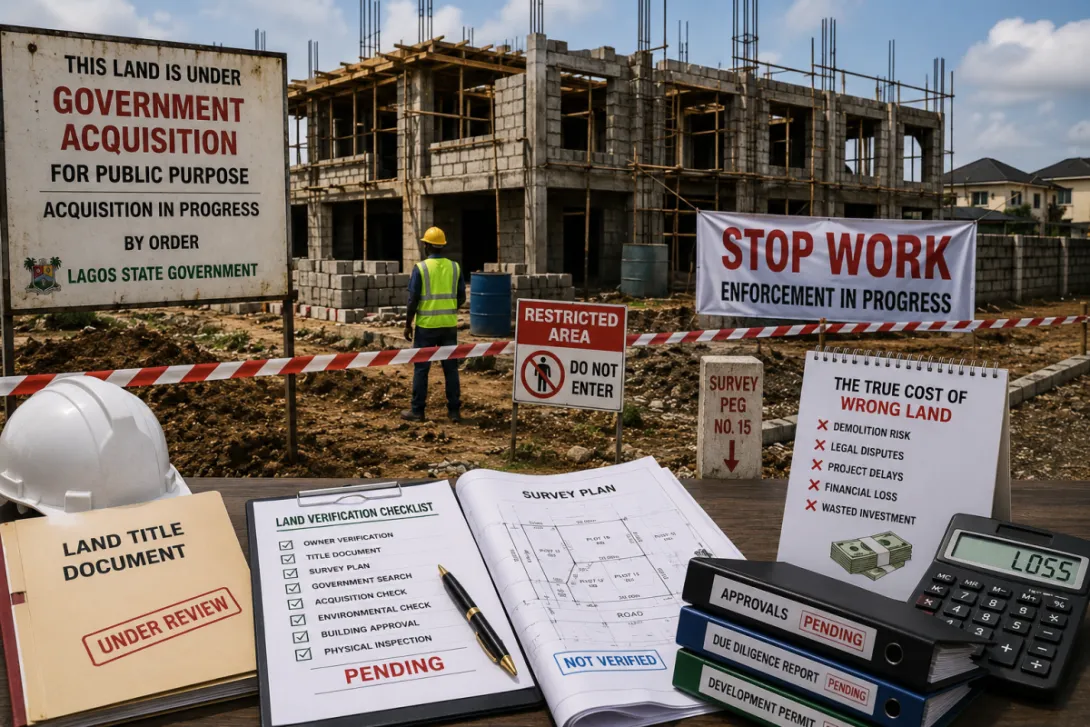
Many people think the biggest cost in property development is the building itself. In reality, the more expensive mistake can be building on the wrong land. If the land has title problems, government acquisition issues, planning restrictions, ownership disputes, or approval defects, the financial damage can go far beyond blocks, cement, and labour. Under the Land Use Act, land rights can be revoked for overriding public interest, and transactions or instruments that purport to confer land rights otherwise than in accordance with the Act are null and void.
That is why this issue matters so much in today’s market. Lagos State recently listed 176 illegal estates and gave an ultimatum for regularization, showing that land status, approvals, and compliance are being watched far more closely than many buyers assume. In practical terms, this means a development can look active on site and still sit on weak legal ground.
The Wrong Land Can Turn Construction Into a Loss
When a project is built on the wrong land, the first loss is not always demolition. Sometimes it starts with delay, stoppage, redesign, legal fees, repeated verification costs, or inability to regularize the project. If the land cannot support the intended use, or if the title chain is defective, the money spent on construction may become trapped in a project that cannot move forward cleanly. Nigerian legal guidance for buyers now repeatedly lists forged documents, defective title, undisclosed encumbrances, government acquisition, and family disputes among the biggest risks in land transactions.
That is why the real cost of wrong land is often cumulative. You may pay for land, mobilize to site, begin construction, buy materials, and then discover that the real problem was never the building budget. It was the land underneath it. In a market where compliance pressure is increasing, that mistake can become more expensive than the structure itself.
Building on Land Under Government Acquisition Is a Major Risk
One of the clearest examples is land under government acquisition. The Land Use Act allows revocation of rights of occupancy for overriding public interest, including land required by the state, local government, or federation for public purposes. Once revocation is properly signified and notice is received, the title of the holder is extinguished.
For a developer, this means construction on the wrong parcel can become a serious financial trap. Even if the site looks free and developable, official status may say otherwise. That is why land under acquisition, committed areas, or land with unresolved government claims can end up costing far more than the building works already completed.
Ownership Problems Can Destroy the Value of the Project
Another reason the wrong land is so dangerous is ownership. A seller may appear to control the land but still lack lawful authority to transfer it. Real estate due diligence guidance in Nigeria consistently warns buyers against relying on verbal assurances, estate agents, family representatives, or unverified documents. If ownership is weak or disputed, the project may carry legal risk from day one.
This is even more sensitive with family or communal land. Nigerian legal commentary notes that such land carries additional customary and consent related issues. If a developer builds first and investigates later, the cost of dispute resolution can become far greater than the original construction budget.
Poor Land Documentation Can Stop a Good Project
A project can also fail because the land documentation is incomplete, mismatched, or not properly regularised. In Lagos, current buyer guidance emphasizes the need to investigate the property’s history, ownership, and legal status before purchase, precisely because demand pressure leads many people to move too quickly. When those checks are skipped, buyers risk fraud, disputes, and legal complications that could have been avoided.
This matters for developers because construction depends on land certainty. If title, survey, planning status, or approvals do not line up, the developer may face stoppage, redesign, or inability to lawfully proceed. In that situation, the land error becomes more expensive than the construction effort already invested.
Why Due Diligence Is Cheaper Than a Land Mistake
The safest way to avoid building on the wrong land is proper due diligence before development starts. Current Nigerian legal guidance describes real estate due diligence as investigating ownership, title, location, physical condition, planning status, encumbrances, tax liabilities, and legal risks before purchase. That is exactly why due diligence costs far less than land failure.
A serious process should include checking the seller’s root of title, verifying survey details, searching official records, confirming planning status, investigating encumbrances, and checking for government acquisition risk. These are not optional extras. They are part of what makes a project bankable, defendable, and safe to build on.
What Smart Buyers and Developers Should Do First
Before any construction begins, smart buyers and developers should verify the land before committing to the build. In today’s market, that means treating land verification as the foundation of the project, not as an afterthought. Lagos enforcement trends and Nigerian due diligence guidance both point in the same direction: do not assume that a visible plot, a signboard, or a verbal promise makes the land safe.
If the land is clean, titled properly, free from hidden claims, and suitable for the intended development, then construction capital has a better chance of being protected. If not, the project may become a long and expensive lesson in why the wrong land costs more than the construction itself.
Final Thoughts
So, why can building on the wrong land cost more than the construction itself? Because wrong land does not only create a land problem. It creates a chain of financial losses through stoppage, dispute, redesign, enforcement, legal exposure, and trapped capital. Under Nigerian law and current market conditions, land mistakes are often project destroying mistakes.
That is why in property development in Nigeria, the smartest money is often spent before construction starts. Verify the land, check the records, confirm the seller’s authority, investigate planning status, and do not let urgency replace due diligence.
Before you build, make sure the land itself is truly safe.
LandMall helps buyers and investors access better property opportunities, and supports clients with practical guidance across land verification, planning, development, and project execution.