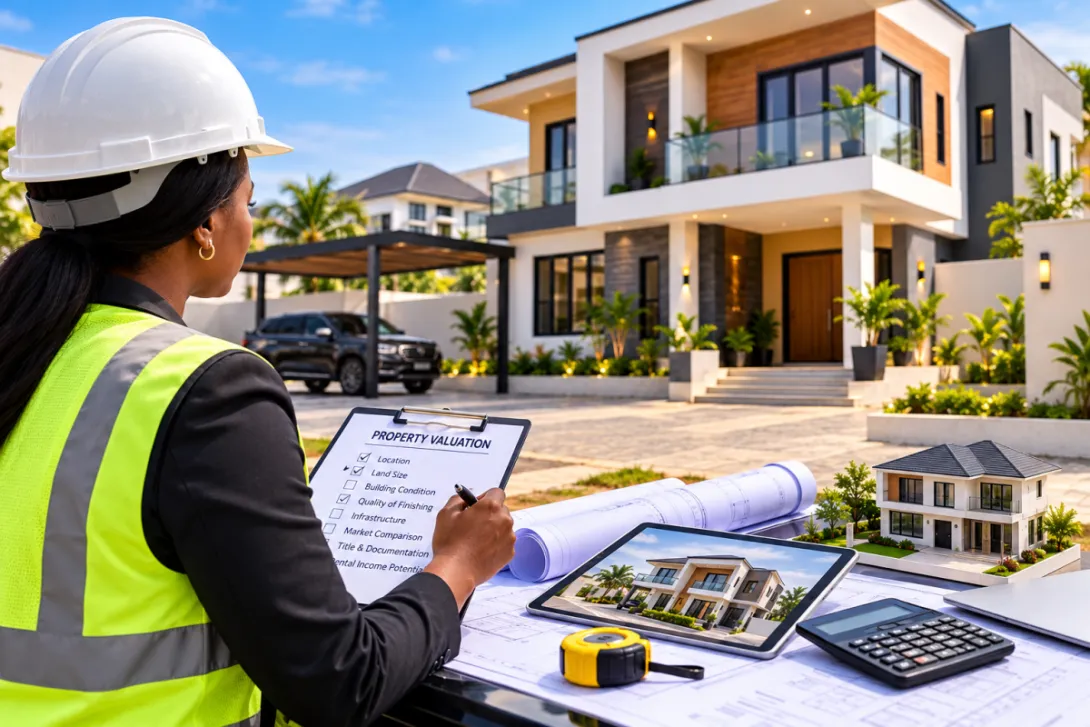
Have you ever wondered why two houses that look almost identical can have completely different prices? Or why a piece of land that a seller claims is worth ₦50 million may be worth considerably less—or potentially more when properly assessed?
Welcome to the Nigerian real estate market, where a seller's asking price, an agent's estimate, and the actual market value of a property can sometimes tell three very different stories.
A property owner may believe their house is worth ₦150 million because of the amount spent building it. A developer may price a new apartment at ₦250 million because it is located in a prestigious neighbourhood. An investor may be willing to pay a premium for a piece of land because of its development potential.
But does the property genuinely justify the price?
Whether you want to buy your first home, sell an inherited property, invest in land, or acquire an apartment for rental income, understanding how to assess property value in Nigeria is essential. Without this knowledge, you could pay more than a property is worth, undervalue an asset you intend to sell, or invest your money in a property that may be difficult to resell.
Property valuation is not simply about looking at a building and deciding how much it should cost. It involves examining relevant market evidence, location, physical condition, legal status, income potential, and other factors that influence what a property is worth.
In this guide, we explain the major factors affecting property value in Nigeria, the methods used to assess property prices, the mistakes to avoid, and the steps you can take before agreeing to a property's asking price.
1. What Does Property Value Really Mean?
Before determining what a property is worth, it is important to understand that asking price and market value are not necessarily the same thing.
The asking price is the amount a seller advertises or requests for a property. The seller may have arrived at that figure after considering construction costs, personal expectations, market information, outstanding financial obligations, or the prices of neighbouring properties.
Market value, on the other hand, is generally an estimate of the price a property would be expected to achieve in an appropriate market, as of a particular date, between willing and knowledgeable parties acting independently and without undue pressure.
In practice, the final transaction price may be above or below the estimated market value.
Consider this example.
A homeowner lists a three-bedroom house in Lagos for ₦120 million. Another house with a similar number of bedrooms in the same general neighbourhood recently sold for ₦95 million.
Does that automatically mean the first house is overpriced?
Not necessarily.
The first property may have a larger plot, better construction, more usable space, superior access roads, or a stronger title position. Alternatively, it may be smaller, require significant repairs, or have a less functional layout.
The difference can only be understood by examining the relevant details.
This is why buyers should not accept an asking price simply because it appears reasonable at first glance. Similarly, sellers should not assume that their property is worth a particular amount merely because a neighbour has advertised a similar property at that price.
The real question is not what the seller wants for the property, but what the available evidence suggests the property is worth.
2. Location: One of the Biggest Factors Affecting Property Value
When assessing property value in Nigeria, location is one of the first factors to examine.
Two properties with similar designs, floor areas, and construction quality can have significantly different values because they are situated in different neighbourhoods.
Even within the same city, property values can vary considerably from one street to another.
For example, a house in Ikoyi may command a substantially higher price than a similar house in a less expensive part of Lagos. However, location differences also exist within Ikoyi itself, depending on the street, accessibility, surrounding development, security, and other characteristics.
When evaluating a property's location, consider the following:
Accessibility: How easily can residents reach the property? Are the access roads motorable throughout the year? Is the property accessible during the rainy season?
Infrastructure: What is the condition of the roads, drainage systems, electricity supply, water infrastructure, and other essential services?
Security: Does the neighbourhood have a reasonable security arrangement? Are there concerns that could affect residents' willingness to live there?
Proximity to essential services: How close is the property to schools, hospitals, markets, shopping centres, workplaces, and public transportation?
Neighbourhood development: Is the area experiencing sustainable growth? Are new businesses, residential developments, and infrastructure projects improving its attractiveness?
Environmental conditions: Is the property in an area prone to flooding, erosion, pollution, or other environmental challenges?
A property in a developing location may offer future appreciation potential, but buyers should distinguish between existing infrastructure and promises about what may be developed later.
A proposed road, railway, shopping centre, or other major project may influence buyer expectations. However, an uncompleted or speculative project should not automatically be treated as a guaranteed increase in property value.
The important lesson is that location matters, but the quality and characteristics of that location matter just as much.
3. Compare Similar Properties Before Accepting the Asking Price
One practical way to estimate property value is to investigate comparable properties.
This is commonly known as the comparable sales method, and it is particularly useful when sufficient reliable information about similar transactions is available.
The principle is straightforward: if similar properties in the same area have recently sold for particular amounts, those transactions can provide useful evidence when estimating the value of another property.
However, the comparison must be fair.
Suppose you are considering buying a four-bedroom detached house in a particular Lagos neighbourhood. You find three other four-bedroom houses advertised in the same area.
Their asking prices are:
- Property A: ₦180 million
- Property B: ₦195 million
- Property C: ₦220 million
It may be tempting to conclude that the property you are considering is worth approximately ₦200 million.
But there is a problem: these are asking prices, not necessarily completed sale prices.
The sellers may have priced their properties above market expectations. Some may eventually accept substantially lower offers, while others may have genuine reasons for asking more.
To make a meaningful comparison, investigate actual completed transactions where reliable information is available.
If confirmed sale prices are unavailable, asking prices can still provide context, but they should be treated cautiously rather than as proof of market value.
You should also compare properties based on:
- Location and street.
- Land size and usable floor area.
- Number of bedrooms and bathrooms.
- Building age and general condition.
- Construction quality and finishing.
- Parking and outdoor space.
- Access roads and neighbourhood infrastructure.
- Title and documentation.
- Service charges and other recurring costs, where applicable.
A newly built house with functional spaces and good construction quality should not automatically be valued in the same way as an older house requiring extensive renovation.
Likewise, two properties described as being in the same neighbourhood may have very different values if one is on an accessible road and the other is difficult to reach.
The closer the comparable properties are to the property being assessed, the more useful the comparison is likely to be.
4. Land Size, Building Size and Usable Space Matter
When assessing property value, do not focus exclusively on the number of bedrooms or the external appearance of a building.
The amount of land, the size of the building, and how efficiently the available space is used can all influence value.
For land purchases, investigate the actual plot dimensions and the land area stated in relevant documents. Do not rely solely on verbal descriptions or a seller's estimate.
For houses and apartments, consider the internal floor area, room dimensions, ceiling heights, natural lighting, ventilation, storage, circulation, and functionality of the layout.
Imagine two three-bedroom apartments in the same neighbourhood.
The first has a spacious living room, well-proportioned bedrooms, adequate ventilation, practical storage, and a functional kitchen.
The second has a narrow living room, cramped bedrooms, limited storage, and a layout that makes ordinary household activities uncomfortable.
Both may be advertised as luxury apartments. Both may have attractive fittings and modern exterior designs.
However, the actual living experience can be very different.
A property should not be valued solely on the strength of its appearance or marketing description. Its functionality should also be considered.
This is particularly important in expensive neighbourhoods, where buyers may pay substantial premiums for location and branding.
A compact property is not necessarily a poor investment. Well-designed smaller homes can be practical, attractive, and financially sensible. The concern arises when the price suggests a level of space, quality, or comfort that the property does not deliver.
For land, also investigate the shape of the plot, topography, access, drainage, setbacks, applicable planning restrictions, and the proportion of the land that can realistically be developed.
A large plot is not automatically more valuable than a smaller one if significant parts of it cannot be used for the intended purpose.
5. Building Quality and Condition Can Increase or Reduce Value
A property's external appearance can be impressive, but appearances alone do not establish its construction quality.
A beautifully painted house with expensive lighting, decorative ceilings, imported fittings, and a modern façade may still have serious defects that affect its value.
When assessing a house for sale, look beyond the finishing.
Important considerations include:
- The condition of the foundation and structural elements.
- Signs of cracks, water penetration, or persistent dampness.
- Roof condition and evidence of leakage.
- Quality of plumbing and electrical installations.
- Drainage and wastewater arrangements.
- Ventilation and natural lighting.
- Quality of doors, windows, floors, and other finishes.
- Evidence of poor workmanship or inadequate maintenance.
- Likely repair and replacement costs.
Not every crack indicates a serious structural problem, and not every visible defect means a property is unsafe. However, unexplained defects should be investigated by appropriately qualified professionals.
For an older property, estimate the likely cost of bringing it into the condition you require.
Suppose a house is offered for ₦100 million, but a professional inspection identifies substantial repairs that are expected to cost ₦15 million.
The effective acquisition cost could be at least ₦115 million before considering transaction expenses and other associated costs.
That does not automatically mean the property is worth only ₦85 million or that the seller must reduce the price by ₦15 million. Its market value still depends on comparable transactions and other relevant factors.
However, the repair estimate is important when deciding whether the purchase makes financial sense.
Similarly, an expensive property should not command a premium merely because the developer has installed attractive fittings. Finishes can contribute to value, but they should be considered alongside the building's overall condition, functionality, construction quality, and market appeal.
Where significant structural concerns exist, arrange an independent inspection before committing to the transaction.
6. Legal Title and Documentation Can Affect Property Value
A property's legal status is an important consideration in Nigeria.
Two plots of land may be similar in size and location but differ in marketability because of their documentation, ownership history, encumbrances, or planning restrictions.
Before purchasing land or a house, investigate the seller's authority to transfer the property and the nature of the interest being sold.
Depending on the transaction, relevant documents may include:
- A Certificate of Occupancy, where applicable.
- A registered deed of assignment.
- A registered survey plan.
- Relevant government allocation or title documents.
- Evidence of the seller's ownership or authority to sell.
- Applicable planning approvals and building approvals.
- Relevant consent, registration, or perfection documents.
The documents required depend on the property's location, ownership history, nature of title, and applicable law. No single document should be treated as a universal guarantee that a property is free from every legal problem.
A professional title investigation may need to examine the relevant land registry, survey records, ownership history, planning requirements, litigation risks, and other issues.
For example, a seller may advertise land at a price significantly below comparable plots in the same neighbourhood. The lower price could reflect an urgent sale, but it could also indicate access difficulties, disputed ownership, encumbrances, planning restrictions, or other concerns.
Do not assume that a low price means you have found a bargain.
At the same time, a property with apparently impressive documentation should not automatically be assumed to be free from defects. The documents and underlying facts must be properly investigated.
Legal due diligence does not replace property valuation, but it helps establish what is being purchased and whether the interest can be safely and lawfully transferred.
Where necessary, engage a qualified property lawyer to investigate the title and a qualified estate surveyor and valuer to assess the property's market value.
7. How Rental Income Can Help You Assess Property Value
If you are buying a property primarily for rental income, its ability to generate sustainable returns should form part of your assessment.
A property may look attractive and be located in a desirable neighbourhood, but the purchase price may be difficult to justify if the rental income is too low relative to the amount invested.
This is where the income approach to valuation becomes useful.
The income approach estimates value by examining the income a property can reasonably generate, taking account of relevant expenses, market conditions, and investment risks.
For a simple preliminary assessment, calculate the gross rental yield.
The formula is:
Gross Rental Yield = (Annual Rental Income ÷ Property Purchase Price) × 100
Consider an example.
You are considering purchasing an apartment for ₦80 million. You reasonably estimate that it can generate annual rent of ₦6 million.
The calculation is:
₦6 million ÷ ₦80 million × 100 = 7.5% gross rental yield.
At first glance, this gives you a useful starting point for evaluating the investment.
However, gross rental yield does not tell the entire story.
You must also consider expenses such as:
- Repairs and maintenance.
- Property management fees.
- Periods when the property is vacant.
- Insurance, where applicable.
- Applicable taxes and statutory charges.
- Service and operational expenses borne by the owner.
- Other recurring costs associated with ownership.
Suppose the property generates ₦6 million annually but incurs ₦1.5 million in annual operating expenses.
Its annual net operating income would be ₦4.5 million, assuming those figures capture the relevant operating expenses and excluding financing costs and other items not included in the estimate.
Using the ₦80 million purchase price, the simplified net operating income yield would be:
₦4.5 million ÷ ₦80 million × 100 = 5.625%.
This is more informative than the gross yield alone, although it is still not a complete measure of investment performance.
You should also assess tenant demand, achievable market rent, vacancy risk, the condition of the property, and the likelihood of future rental growth.
Do not rely solely on the rental income a seller claims the property can generate. Compare the estimate with rents for similar properties and distinguish between advertised rents and amounts landlords actually receive.
A property with a higher purchase price may still be a sensible investment if it generates stronger, more reliable income or offers other advantages. Conversely, a cheaper property may deliver disappointing returns if it remains vacant or requires frequent repairs.
Rental yield is one tool for assessing value, not a substitute for a complete valuation.
8. Consider Future Development Potential—but Do Not Pay for Unverified Promises
Some properties derive part of their value from what they may be able to support in the future.
A plot of land may become more attractive if it is suitable for residential development, commercial use, subdivision, or another lawful and economically viable purpose.
However, development potential must be assessed carefully.
Before paying a premium for land because of its supposed potential, investigate:
- Applicable zoning and permitted land use.
- Planning and development restrictions.
- Road access and infrastructure.
- Drainage and environmental conditions.
- Availability of relevant utilities.
- Applicable setbacks and building requirements.
- Whether the proposed development is physically and financially feasible.
- Whether any necessary approvals can reasonably be obtained.
For example, a plot may be advertised as ideal for a block of flats. Yet its dimensions, access, zoning, setbacks, parking requirements, or other restrictions may make the proposed development impractical.
The seller's description does not establish what can legally be built.
Similarly, claims that an area will soon become the next major commercial hub should be supported by credible information rather than speculation.
Future appreciation is possible, but it is not guaranteed.
When assessing land value, distinguish between what the land can support today and what may become possible if future developments or approvals materialise.
9. Understand the Difference Between Cost and Market Value
One of the most common mistakes in real estate is assuming that the amount spent on a property determines its current market value.
It does not.
A homeowner may have spent ₦120 million acquiring land, constructing a building, installing fittings, and landscaping the compound. That does not automatically mean the finished property is worth ₦150 million.
The market may support a higher value, a lower value, or approximately the same amount.
Why?
Because buyers do not necessarily pay for every decision a property owner makes.
A seller may spend heavily on imported fittings, decorative features, or a highly personalised interior design. But if prospective buyers do not place equivalent value on those features, the expenditure may not translate into a corresponding increase in the property's market value.
Similarly, construction costs may rise significantly without property prices increasing at the same rate. Buyers' purchasing power, available alternatives, rental demand, financing conditions, and other market factors influence what they can and will pay.
This distinction is particularly important when evaluating newly built houses.
A developer may explain that the property's price reflects expensive land, rising building-material costs, labour, financing, approvals, and other expenses. Those costs are relevant to the developer's business decisions.
However, the buyer must still assess whether the completed property represents reasonable value compared with alternatives in the market.
What it cost to build a property and what the market is willing to pay for it are two different questions.
10. Do Not Ignore the Total Cost of Ownership
When evaluating a property, look beyond the purchase price.
Some properties have substantial recurring expenses that can affect their attractiveness to buyers and investors.
For example, a luxury apartment may be priced competitively compared with similar properties, but its annual service charges could be significant.
A house may appear affordable but require extensive repairs, new plumbing, electrical upgrades, or drainage improvements.
A property in a developing location may also require additional expenditure on access, utilities, security, or other infrastructure, depending on the circumstances.
Before making a decision, investigate the likely costs associated with:
- Legal fees and applicable transaction charges.
- Title registration, consent, and other perfection costs, where applicable.
- Agency fees, where payable.
- Repairs and renovations.
- Service charges and estate levies.
- Insurance and maintenance.
- Utility connections or improvements.
- Applicable taxes and statutory obligations.
Not every cost applies to every transaction, and the amount depends on the property and the relevant circumstances.
These expenses do not all form part of a property's market value. Instead, they help you determine the total financial commitment involved and whether the purchase is suitable for your budget and objectives.
A property that appears inexpensive at first may become costly once the additional obligations are considered.
11. Common Mistakes People Make When Assessing Property Value
Even experienced buyers can make mistakes when evaluating property prices. Some of the most common include the following.
Mistake 1: Assuming the Asking Price Is the Market Value
A seller can ask any price they consider appropriate, subject to applicable law. That does not mean buyers will pay it.
Investigate comparable properties and seek independent professional advice where necessary.
Mistake 2: Comparing Properties Based Only on Location
Two houses on the same street can differ in land size, construction quality, title, condition, layout, and development potential.
Location is important, but it is not the only consideration.
Mistake 3: Allowing Attractive Finishing to Distract You
Decorative ceilings, imported tiles, modern kitchens, and attractive swimming pools may improve a property's appeal. They do not, by themselves, establish that the building is structurally sound or fairly priced.
Examine the entire property.
Mistake 4: Assuming Every Developing Area Will Appreciate Rapidly
Property prices can rise, stagnate, or fall. Infrastructure improvements and economic growth may support appreciation, but speculative expectations should not be treated as guaranteed returns.
Mistake 5: Ignoring Legal and Physical Risks
A property with title complications, access problems, planning restrictions, or significant defects may be less marketable or more expensive to own than it first appears.
Investigate these issues before committing your money.
Mistake 6: Confusing an Investment With an Emotional Purchase
A house may be your dream home because it is close to family, has a beautiful garden, or offers a particular lifestyle.
Those preferences are valid.
However, if you are buying primarily for investment, you must also examine the financial evidence, potential rental income, resale prospects, and risks.
Your personal preferences and the property's market value may not always be identical.
12. When Should You Engage a Professional Property Valuer?
Online research and property comparisons can help you form an initial opinion, but they do not replace a formal valuation when one is needed.
Consider engaging a qualified estate surveyor and valuer when:
- You are purchasing an expensive property.
- You suspect that a property is significantly overpriced.
- You are selling an inherited property and need an objective estimate.
- You are assessing a property for investment purposes.
- You need a valuation for financing, accounting, insurance, litigation, or another formal purpose.
- You are dealing with a commercial property or a complex development.
- You need an independent assessment to support negotiations.
In Nigeria, professional valuation services should be obtained from appropriately qualified and registered estate surveyors and valuers, as applicable to the purpose and circumstances of the engagement.
A professional valuation should consider relevant evidence and clearly state the basis, assumptions, and purpose of the valuation.
Depending on the assignment, the valuer may examine comparable transactions, the property's physical characteristics, title information, income potential, development potential, and other relevant factors.
Remember that a valuation is an informed professional opinion based on available evidence and the specified valuation basis and date. It is not a guarantee that a property will sell for a particular amount.
For a major transaction, a valuation can help you negotiate from a more informed position and reduce the risk of relying entirely on a seller's expectations.
13. A Practical Checklist Before Agreeing on a Property Price
Before accepting an asking price, ask yourself the following questions:
About the market
- Have I investigated comparable properties in the same area?
- Do I have reliable information about actual sale prices, where available?
- Is the asking price consistent with the property's features and condition?
About the location
- Are the access roads and infrastructure satisfactory?
- Is the neighbourhood suitable for my intended use?
- Are there environmental or accessibility concerns?
About the property
- Is the land size or floor area properly established?
- Is the layout functional?
- Have I assessed the construction quality and general condition?
- Will I need to undertake major repairs or renovations?
About the legal position
- Has the seller's ownership or authority to sell been verified?
- Have the title and relevant property documents been investigated?
- Are there encumbrances, disputes, or planning restrictions that could affect the transaction?
About the finances
- What is the total acquisition cost beyond the purchase price?
- If I am buying for rental income, what is the realistic rental yield?
- Can I afford the ongoing maintenance and service costs?
- Will the property meet my financial objectives?
About professional advice
- Do I need an independent valuation?
- Should a property lawyer investigate the title?
- Should a building professional inspect the structure?
If you cannot answer several of these questions confidently, consider obtaining further information before making an offer.
Conclusion: Know the Value Before You Commit Your Money
A property's advertised price may attract your attention, but it should not be the only factor guiding your decision.
Understanding how to assess property value in Nigeria requires you to look at the market evidence, location, land and building characteristics, construction quality, legal status, income potential, and the costs associated with ownership.
For buyers, this knowledge can help prevent overpayment and support more informed negotiations.
For sellers, it can help establish realistic expectations, improve pricing decisions, and reduce the risk of leaving a property on the market for too long.
For investors, it provides a stronger basis for evaluating potential returns, comparing opportunities, and identifying risks before committing substantial capital.
Ultimately, a property is not valuable simply because the seller says it is expensive, because it is located in a prestigious neighbourhood, or because it has attractive finishing.
Its value must be considered in the context of the market, its actual characteristics, its legal position, and the purpose for which it is being acquired.
Before you buy, sell, or invest, take the time to investigate the evidence. Ask the right questions. Seek professional advice when necessary. And never allow the pressure to close a deal to replace proper assessment.
The smartest property decision is not necessarily buying the cheapest property or the most expensive one. It is understanding what you are paying for and whether the price makes sense.
Looking to Buy, Sell or Invest in Property?
At LandMall, we believe that informed decisions are the foundation of successful property ownership and investment.
Whether you are searching for land, buying a home, selling a property, or exploring real estate investment opportunities, take the time to understand the property, verify the relevant information, and assess whether the opportunity aligns with your objectives.
Visit LandMall.ng to explore property opportunities and take your next step towards making a more informed real estate decision.
LandMall — Find your property. Understand its value. Invest with insight.