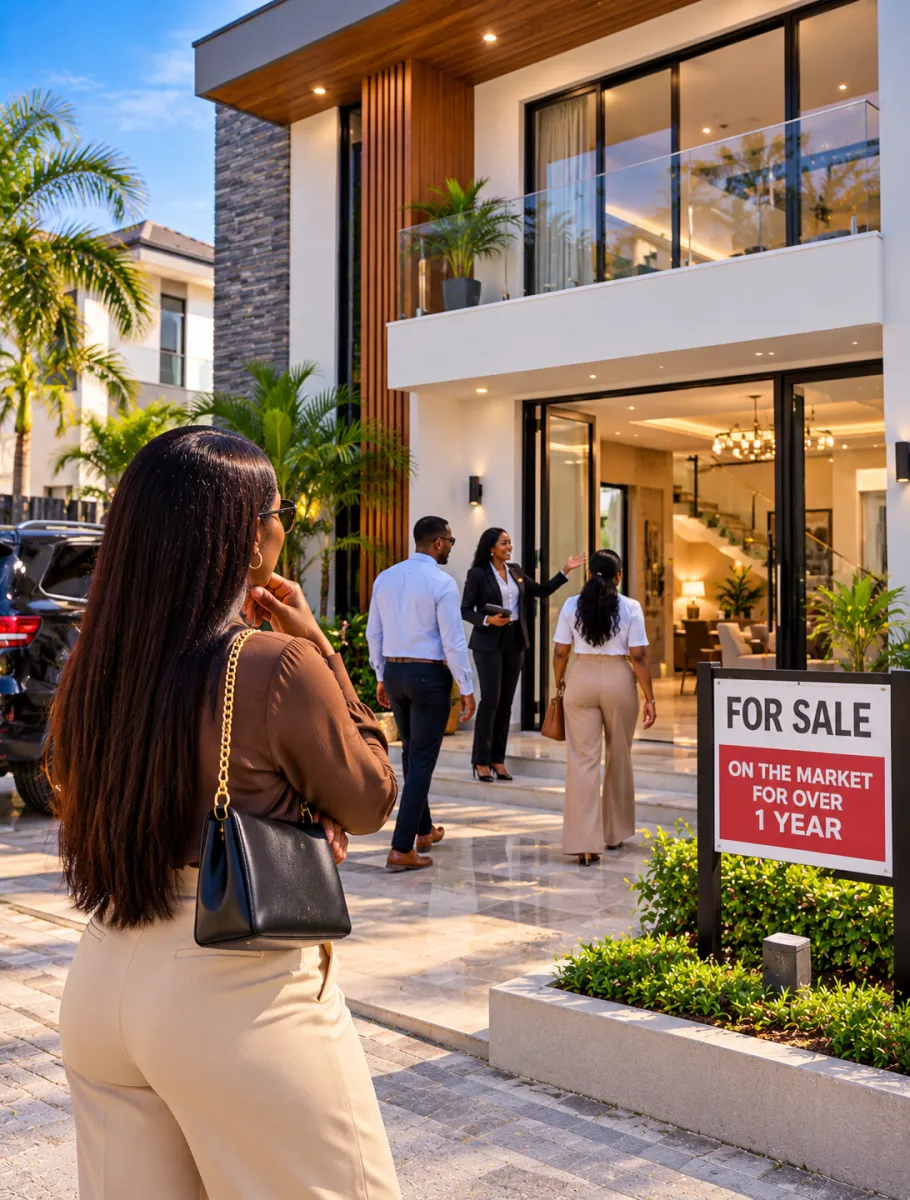
When you buy a property, you are probably thinking about one thing:
“Can I afford it?”
But there is another question you should ask before you pay:
“If I need to sell this property five years from now, will someone else want to buy it?”
That question is important because buying property is not only about getting ownership. It is also about liquidity, demand and future marketability.
A property may look beautiful today. It may even be in a popular location. But when you eventually want to sell, you may discover that finding a serious buyer is harder than you expected.
And that is when you realise:
Not every property is easy to resell.
In Lagos, where property prices, infrastructure, demand and development patterns vary significantly from one neighbourhood to another, understanding resale potential should be part of your buying decision.
Current Lagos market research also shows how differently various submarkets can behave, with factors such as scarcity, rental demand, infrastructure, title quality and supply affecting property performance.
So, what makes a property difficult to sell later?
Let's talk about it.
1. A Bad or Weak Location
You've probably heard the saying:
“Location, location, location.”
It sounds overused, but there is a reason it remains one of the most important principles in real estate.
You can renovate a house.
You can repaint it.
You can change the kitchen.
You can upgrade the bathrooms.
But you cannot easily move the property to a better neighbourhood.
A property may become difficult to sell if it is located in an area with:
- Poor road access
- Serious flooding or drainage problems
- Limited public transportation
- Poor security
- Weak electricity infrastructure
- Few social amenities
- Low residential demand
- Limited commercial activity
- Difficult access during peak traffic
This does not mean an emerging location is automatically a bad investment.
In fact, some emerging areas can offer significant opportunities when infrastructure and economic activity are developing. Agusto & Co.'s 2026 Lagos report, for example, highlights infrastructure-led development and population pressure as important factors shaping property demand across Lagos.
The important thing is to understand why the location is expected to grow, rather than simply buying because someone says it is “the next big thing.”
2. Poor Accessibility
Imagine two houses that are almost identical.
One is easy to reach from a major road.
The other requires driving through several difficult roads before you get there.
Which one do you think will attract buyers more easily?
Accessibility matters.
People don't just buy the building. They buy the convenience that comes with the location.
Think about:
- How long does it take to reach the property?
- What is the condition of the access road?
- Is the road motorable throughout the year?
- How accessible is the property during heavy rain?
- How close is it to major roads?
- Can residents easily get transport?
- How far is it from major employment and commercial centres?
A beautiful house that is frustrating to reach can have a much smaller buyer pool.
And a smaller buyer pool can mean a longer time on the market.
3. A Property With Documentation Problems
This is one of the biggest issues you should take seriously.
Imagine buying a property today and discovering five years later that your prospective buyer's lawyer has concerns about the title.
Your buyer may ask:
“Where is the Deed of Assignment?”
“Has the title been perfected?”
“What is the root of title?”
“Has the property been properly registered?”
“Are there any encumbrances?”
If you cannot provide satisfactory answers, the transaction can become difficult.
Documentation problems don't necessarily announce themselves when you buy.
Sometimes they become obvious when you try to sell, obtain financing or transfer the property.
This is particularly important with land in developing areas. Current Lagos market research identifies title and documentation defects as a significant risk in growth-corridor purchases.
So don't wait until you have a buyer before discovering that your documentation needs attention.
Do the due diligence before you buy.
4. An Unclear or Defective Title
This deserves special attention.
There is a difference between having a pile of documents and having a legally defensible title.
A property may come with documents, but that does not automatically mean the transaction is safe.
For example, questions may arise around:
- The seller's authority
- Root of title
- Government acquisition
- Existing interests
- Family or community claims
- Encumbrances
- Registered interests
- Boundaries
- Planning restrictions
And if your eventual buyer discovers a serious problem during their own due diligence, they may walk away.
That is why a property title should not only be considered from the perspective of “Can I buy this?”
You should also ask:
“Will another buyer's lawyer be comfortable with this title when I want to sell?”
5. Buying at an Inflated Price
This is another common problem.
Suppose you buy a property for ₦200 million because the seller tells you:
“Properties around here are already going for ₦220 million.”
Five years later, you want to sell.
But comparable properties are actually selling around ₦190 million.
Now you have a problem.
You may own a perfectly good property.
The location may be fine.
The building may be beautiful.
But you overpaid at the point of entry.
This is why asking price is not the same thing as market value.
Before buying, compare:
- Similar properties
- Recent transactions where available
- Property size
- Building condition
- Location
- Title
- Amenities
- Rental income
- Development quality
Don't let urgency convince you that every asking price is justified.
6. A Property That Is Too Expensive for Its Market
Here's something people don't always consider:
Who is the next buyer?
If you buy a property that only a tiny group of people can afford, your resale market may be very small.
For example, a property may be beautiful but priced far above what comparable buyers in that neighbourhood are willing or able to pay.
The result?
You may eventually have to:
- Wait longer
- Reduce your price
- Spend more on marketing
- Accept difficult negotiations
- Offer incentives
The Lagos market is not one single market. Different corridors attract different types of buyers and tenants, and current market data shows substantial variation in pricing, yields and demand across submarkets.
So don't only ask:
“Can I afford this property?”
Also ask:
“Who will be able to afford it when I want to sell?”
7. Unusual Property Designs
Unique can be attractive.
But too unique can become a problem.
Imagine a house with an unusual layout that perfectly matches your lifestyle.
You love it.
But the next buyer doesn't.
That buyer wants:
- More bedrooms
- A conventional living room
- Better parking
- A standard kitchen layout
- More outdoor space
- A BQ
- A home office
Suddenly, your “special” property has become a niche property.
The more specific a property's design is to one person's taste, the smaller its potential buyer pool may become.
This doesn't mean you should buy boring properties.
It means you should think about market appeal, not only personal taste.
8. Poor Construction or Building Quality
A property can look fantastic in photographs and still have serious problems.
Potential buyers may notice:
- Cracks
- Water damage
- Poor drainage
- Roof problems
- Plumbing issues
- Electrical defects
- Poor finishing
- Structural concerns
- Low-quality fittings
- Poor maintenance
And today's buyers are becoming more careful.
If the buyer has to spend a significant amount of money immediately after purchase, they will factor that into their offer.
Sometimes they will simply move on to another property.
That is why construction quality is not just about enjoying the property today.
It can affect the property's future resale value.
9. High Service Charges and Running Costs
This is particularly important for apartments and serviced developments.
A property may look attractive because of its gym, swimming pool, security, elevator, generator and other facilities.
But those facilities cost money to operate.
If service charges become excessively high, potential buyers may start asking:
“How much will this property actually cost me every year?”
Current Lagos market research highlights service charges, management costs and vacancy as factors that can materially affect the economics of premium apartments.
And remember: a future buyer is not only looking at your selling price.
They are looking at the total cost of owning the property.
10. Poor Rental Demand
Even if you are not buying the property primarily for rental income, rental demand can influence resale.
Why?
Because investors are part of the property market.
If investors know that a particular type of property is difficult to rent out, they may be less interested in buying it.
On the other hand, a property that attracts reliable tenants can have a broader pool of potential buyers.
This is one reason you should understand the rental market in an area before buying an investment property.
Ask:
- What type of tenants live here?
- What is the typical rent?
- How quickly do comparable properties get occupied?
- Are there many vacant units?
- What types of properties are most demanded?
Don't assume that because people are buying houses in an area, they will automatically rent them.
11. Buying Into an Oversupplied Development
Here's another one people often overlook.
Imagine a new estate has 500 similar apartments.
You buy one.
So do 300 other people.
When you eventually want to sell, you are competing against hundreds of owners offering almost the same product.
That can make differentiation difficult.
Current Lagos market analysis has identified localised oversupply risks in certain apartment segments, showing why investors should examine the actual supply pipeline rather than assuming that demand will absorb every new unit.
Before buying into a large development, ask:
“How many similar properties will I be competing with when I want to sell?”
12. Poor Maintenance
A property that was beautiful when purchased can become unattractive if it is poorly maintained.
Imagine two identical apartments.
One is:
- Well painted
- Clean
- Properly managed
- Professionally maintained
- Free from obvious defects
The other has:
- Broken fittings
- Dirty common areas
- Poor landscaping
- Damaged walls
- Faulty elevators
- Poor security
Even if the properties were once worth the same amount, buyers may view them very differently later.
Your property is not only an asset.
It is an asset that needs to be maintained.
13. Buying Based Only on Future Promises
This is particularly common with emerging locations.
You hear:
“The new road will pass here.”
“A major development is coming.”
“The airport is coming.”
“The area will become the next Lekki.”
Maybe.
But before paying a premium based on a future promise, verify the facts.
Is the project approved?
Has construction started?
What is the current stage?
Who is responsible?
What is the realistic timeline?
And most importantly:
What happens if the project is delayed?
Infrastructure can create property opportunities, but infrastructure expectations also carry execution risk. Current Lagos market research specifically notes the importance of infrastructure timing in assessing growth corridors.
Don't buy the promise.
Buy based on evidence and understand the upside and the risk.
So, What Makes a Property Easy to Sell Later?
There is no guarantee that a property will sell quickly.
But properties with strong resale potential often have several things going for them:
✔ Good location
The property is in an area people genuinely want to live, work or invest in.
✔ Clear documentation
The title and ownership history can withstand proper due diligence.
✔ Strong accessibility
People can actually get to the property conveniently.
✔ Appropriate pricing
The property was acquired at a price that makes sense relative to comparable properties.
✔ Broad market appeal
The property can appeal to more than one very specific type of buyer.
✔ Good condition
The building has been properly maintained.
✔ Real demand
There are genuine buyers or tenants for that type of property.
✔ Reasonable running costs
Ownership costs do not make the property unattractive.
✔ Strong surrounding development
The neighbourhood has real economic and infrastructural activity supporting demand.
Before You Buy, Think Like the Future Buyer
This is probably the best habit you can develop as a property buyer.
Don't only look at the property through your own eyes.
Look at it through the eyes of the person who may buy it from you.
Ask:
Would I still want this property if I were seeing it for the first time today?
Would I like the location?
Would I accept the title?
Would I be comfortable with the access road?
Would the price make sense?
Would I be happy with the service charge?
Would I want the layout?
Could I rent it out?
Would I be comfortable reselling it?
If you cannot confidently answer those questions, don't rush.
The Bottom Line
Buying property is a long-term decision.
And while nobody can predict exactly what the market will look like five or ten years from now, you can reduce unnecessary risk by making better decisions today.
Don't buy simply because a property is beautiful.
Don't buy simply because the price is cheap.
Don't buy simply because everyone is buying in the area.
And don't buy solely because someone promises that the property will double in value.
Look at the location, title, accessibility, demand, pricing, quality, running costs and future marketability.
Because when the day comes that you need to sell, you don't want to discover that you bought a property that was easy to buy…
but difficult to sell.
Invest With Insight
Before you buy, think beyond the purchase.
Ask not only, “Can I buy this property?” but also, “Will someone want to buy it from me later?”
At LandMall, we help you make more informed property decisions by helping you assess opportunities based on location, property type, demand and your investment objectives.
Buy with today in mind.
Invest with tomorrow in mind.
Explore property opportunities with LandMall.