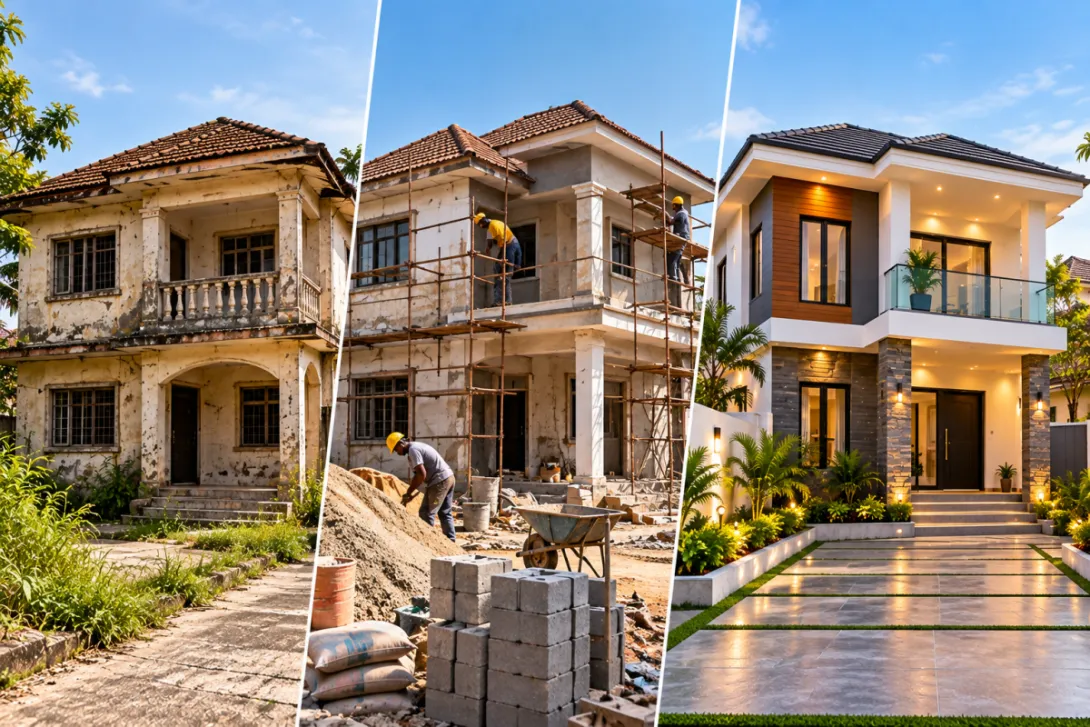
An Old House Is Not Always a Renovation Project
Imagine you own an old house in Lagos.
The building has been standing for years. The tiles are outdated, the kitchen needs attention, the bathrooms look old-fashioned and the exterior needs a fresh coat of paint.
You begin to wonder whether you should renovate it.
Then you consider another option: demolishing the building and constructing something more modern.
But there is a third possibility. What if you sold the property in its current condition and allowed another buyer to decide what to do with it?
Which option makes the most financial sense?
This is a question many homeowners, property investors and developers face when dealing with older properties.
The temptation is to assume that renovation is always the cheaper option or that demolition and rebuilding will automatically create more value.
Neither assumption is necessarily correct.
A property may need only a few improvements to become attractive again. Another may require extensive structural work that makes renovation uneconomical. In some cases, the land itself may be more valuable to a buyer interested in redevelopment than the existing building.
The right decision depends on the condition of the property, the cost of each option, the location, market demand and what you ultimately want to achieve.
Before spending your money, let's examine the three options.
1. Option One: Renovate the Existing House
Renovation involves improving an existing building to make it more functional, attractive, comfortable or valuable.
Depending on the property's condition, the work could range from simple cosmetic improvements to substantial repairs and alterations.
For example, you might need to repaint the building, replace damaged tiles, modernise the kitchen, upgrade the bathrooms, repair the roof or improve the plumbing and electrical installations.
In other cases, renovation could involve changing the layout, improving ventilation, creating additional storage or making better use of available space.
When does renovation make sense?
Renovating an old house may be appropriate when:
The structure is still sound.
If the building's foundations, structural elements and other essential components are in satisfactory condition, improving the existing house may be more economical than demolishing it.
A qualified building professional should assess any suspected structural problems before you commit to the work.
The location is desirable.
An older house in an established neighbourhood may benefit from good road access, proximity to workplaces, schools, commercial centres and other amenities.
If the location attracts buyers or tenants, improving the existing property may be a practical way to make it more competitive.
The required improvements are manageable.
If the roof, plumbing, electrical installations and major structural components are in good condition, you may not need an extensive reconstruction project.
The market supports the finished property.
Even if renovation is technically possible, you must establish whether the completed house will appeal to buyers or tenants at a price that justifies the investment.
What should you consider before renovating?
Do not estimate renovation costs based only on paint, tiles and fittings.
The real cost may include labour, materials, professional fees, repairs to hidden defects, temporary security, waste removal and other expenses.
You should also consider the time required to complete the work and the cost of holding the property during that period.
Most importantly, compare the expected market value after renovation with the total amount you will have invested.
A beautiful house is not automatically a profitable investment.
Renovation makes financial sense when the improvements address real needs and the resulting property value or income justifies the cost.
2. Option Two: Sell the Property As-Is
Sometimes, the best decision is not to renovate at all.
Selling a property as-is means offering it in its current condition, with appropriate disclosure of known defects and compliance with applicable legal obligations.
The buyer assesses the property and decides whether to occupy it, renovate it or redevelop it.
This approach can be useful when the owner does not want to commit additional capital to an ageing building.
When should you consider selling as-is?
You do not have the funds for renovation.
A renovation project can become financially stressful when the owner has insufficient capital to complete the work.
Rather than begin a project that may remain unfinished, you may prefer to sell the property and use the proceeds for another purpose.
The cost of renovation is too high relative to the likely selling price.
Suppose you discover that renovating the house would require a substantial investment, but comparable properties suggest that the completed building would command only a modest increase in price.
Spending the money may not be worthwhile.
Selling in its current condition could be the more sensible financial decision.
You want to avoid construction delays.
Renovation can take longer than expected, particularly when hidden defects emerge or materials and labour become more expensive.
If you do not want to manage the project, selling the property may allow you to move on without taking on those responsibilities.
The land may interest a different type of buyer.
A developer might be more interested in the property's location, plot size and redevelopment potential than in the existing building.
However, redevelopment potential must be assessed against planning rules, permitted land use, setbacks, access, infrastructure and other relevant requirements.
Do not assume that every old building can legally be replaced with a larger or more profitable development.
What are the disadvantages of selling as-is?
Selling without renovation does not guarantee a faster sale.
Some buyers may be concerned about repair costs, hidden defects or the effort required to modernise the property.
Others may deduct their estimated renovation expenses from the amount they are willing to offer.
You may therefore need to price the property competitively and explain its genuine strengths.
If the property has a large plot, good accessibility, useful existing structures or a desirable location, highlight those advantages.
Ensure that the available ownership documents are organised and that any title concerns are addressed appropriately.
Selling as-is can help you avoid additional investment, but the asking price must reflect the property's actual condition and the market's expectations.
3. Option Three: Demolish and Rebuild
Demolition and rebuilding involve removing the existing building and constructing a new one.
This may be worth considering when the old house no longer meets the intended use, has extensive defects or occupies land that could potentially support a more suitable development.
For example, an ageing building on a well-located plot might be replaced with a modern family home, subject to the property's planning and physical constraints.
A developer might also investigate whether the site could accommodate a different residential configuration.
However, the fact that a building is old does not automatically mean it should be demolished.
When might rebuilding make sense?
The building has extensive defects.
If significant structural deterioration or widespread building-system failures make rehabilitation impractical, rebuilding may deserve serious consideration.
This decision should follow a professional assessment rather than assumptions based on appearance alone.
The existing layout cannot meet the intended purpose.
Perhaps the rooms are poorly arranged, the building has insufficient functional space or the design does not suit the needs of the target market.
If meaningful alterations would require extensive reconstruction, a new building may offer greater design flexibility.
The location supports a different property concept.
An established residential area may have demand for a different type of housing than the one currently on the plot.
However, market demand alone is insufficient. You must also establish what the site can legally and physically accommodate.
The projected numbers justify rebuilding.
The potential value of the completed development must be sufficient to justify acquisition or land value, demolition, design, construction, professional fees, approvals, financing and other project costs.
What are the risks?
Rebuilding can be more expensive and complex than many investors expect.
You may need to account for:
- Demolition and waste disposal.
- Architectural and engineering services.
- Planning approvals and other statutory requirements.
- Site preparation.
- Foundation and structural works.
- Construction materials and labour.
- Plumbing and electrical installations.
- Finishing and external works.
- Security and insurance where applicable.
- Financing and holding costs.
- Marketing and selling expenses.
- Contingency for unforeseen circumstances.
There is also the risk that construction takes longer than planned or that the market changes before the new property is completed.
If you are building to sell, the anticipated selling price must justify the entire development cost.
If you are building to rent, the expected rental income should be assessed against the total investment and ongoing expenses.
Rebuilding should be a carefully evaluated development decision, not simply a reaction to an outdated building.
4. Location Can Change the Entire Decision
Two houses of similar age and condition can require completely different investment strategies because they are located in different neighbourhoods.
Consider an old house in an established part of Lagos with good accessibility, strong demand and a large plot.
Now compare it with an old house in a location where demand is limited, access is difficult or the surrounding area presents significant infrastructure challenges.
The first property may justify targeted renovation or redevelopment.
The second may require a much more cautious assessment, regardless of how attractive the proposed design looks.
Before deciding what to do with an old house, examine the location.
Ask yourself:
- Is there genuine demand for property in this neighbourhood?
- Who is buying or renting in the area?
- What types of houses attract the most interest?
- How accessible is the property?
- What infrastructure is available?
- Are there drainage or flooding concerns?
- What are comparable properties worth?
- Are there restrictions affecting redevelopment?
- Is the neighbourhood attracting businesses, residents or other development?
- How easily could the finished property be sold or rented?
Do not base your decision solely on what you believe the neighbourhood will become in the future.
Distinguish between existing infrastructure, verified development plans and speculative promises.
A good location can create opportunities, but it does not eliminate the need for sound budgeting and market research.
5. Calculate the Numbers Before Choosing an Option
This is where many property owners make costly mistakes.
They decide to renovate because they believe it will be cheaper than rebuilding. Others choose demolition because they assume a new building will automatically sell for much more.
Neither approach is reliable without proper costing.
Let's consider an illustrative example.
Suppose you own an old house in Lagos and want to determine whether to renovate it, sell it as-is or demolish and rebuild.
Assume the following estimates:
| Item | Illustrative Amount |
|---|---|
| Estimated current sale value | ₦100 million |
| Estimated renovation cost | ₦20 million |
| Estimated sale value after renovation | ₦130 million |
| Estimated demolition and rebuilding cost | ₦80 million |
| Estimated sale value after rebuilding | ₦200 million |
At first glance, rebuilding appears attractive because the completed property could potentially sell for ₦200 million.
But look more closely.
Option A: Sell As-Is
Estimated selling price: ₦100 million.
You avoid spending additional money on renovation or reconstruction, although selling expenses and any applicable taxes still need to be considered.
Option B: Renovate
Estimated selling price: ₦130 million.
Estimated renovation cost: ₦20 million.
The difference between the estimated selling price and renovation cost is ₦110 million.
However, that is not your profit. You must also account for the value of the existing property, selling expenses, holding costs and other relevant costs.
Compared with selling immediately for ₦100 million, the renovation adds a projected ₦30 million to the sale price while requiring ₦20 million in renovation expenditure.
That leaves an illustrative ₦10 million incremental margin before additional costs and risk.
Option C: Demolish and Rebuild
Estimated selling price: ₦200 million.
Estimated demolition and rebuilding cost: ₦80 million.
The difference is ₦120 million.
But this figure excludes the value of the existing property, demolition and other costs if they are not already included, professional fees, approvals, financing, holding costs and selling expenses.
The fact that the difference is higher does not automatically make rebuilding the best option.
You must also consider the additional capital required, project duration, construction risk and whether the projected selling price is realistic.
These figures are hypothetical and are not current market valuations for Lagos properties.
The correct comparison is not simply which option produces the highest selling price. It is which option offers the best risk-adjusted financial outcome after all costs, time and uncertainties are considered.
6. Do Not Overlook the Value of the Land
Sometimes, the most valuable part of an old property is not the building. It is the land beneath it.
This can happen when a property is located in an established neighbourhood where demand, accessibility and development potential make the plot attractive.
A buyer may be interested in the land because the existing building no longer suits their needs.
However, land value should not be assessed in isolation.
Consider the plot size, title, location, accessibility, permitted use, physical characteristics and potential development constraints.
For example, a large plot may appear suitable for multiple housing units, but setbacks, access requirements, planning restrictions, drainage conditions and other limitations may reduce the usable development area.
Before assuming that demolition will unlock substantial value, establish what can realistically and lawfully be built.
Also consider whether the land has environmental or title-related complications that could affect its marketability.
Do not demolish a building based on an imagined development opportunity. Verify the opportunity first.
7. Think About Who Will Buy the Finished Property
Before renovating or rebuilding, identify the person or organisation most likely to buy the property.
This may sound obvious, but it can fundamentally change your strategy.
If your target buyers are families, they may value practical room arrangements, security, parking, access to schools and proximity to workplaces.
If your target buyers are investors, they may focus more heavily on achievable rental income, maintenance costs, tenant demand and potential returns.
If your target buyer is a developer, the plot size, title, planning possibilities and location may matter more than the current building's finishing.
The mistake is spending money on features that your eventual buyer does not value enough to justify their cost.
For example, installing expensive imported fittings may make a property look impressive, but it may not significantly increase what buyers in that neighbourhood are willing to pay.
Similarly, building a larger house does not guarantee a better return if the location's buyer market cannot support the price.
Before committing to a design, investigate comparable properties and understand the preferences of the people you intend to attract.
Do not design the property around your personal preferences alone. Design your investment strategy around a clearly understood market.
8. What If You Want to Keep the Property and Earn Rental Income?
Selling is not the only possible objective.
You may want to retain the property and generate rental income.
In that case, the decision to renovate, sell as-is or rebuild should be assessed differently.
A renovation may be worthwhile if it improves the property's condition, attracts suitable tenants, reduces recurring maintenance problems or supports a realistic increase in rent.
Rebuilding may be worth considering if the existing structure is unsuitable for the rental market and the projected rental income can justify the additional investment.
However, a new building will usually require a larger capital commitment, and the resulting rental income must be sufficient to make the project financially sensible.
Before making a decision, compare:
- Expected annual rental income.
- Renovation or construction costs.
- Maintenance and management expenses.
- Vacancy risk.
- Insurance and applicable statutory charges.
- Financing costs.
- The property's likely long-term value.
- Alternative uses for the capital.
Also consider the demand for the proposed property type.
A large luxury house may be suitable in one location but difficult to rent at the desired price in another.
The best property decision depends on your objective. A property intended for rental income should not automatically be evaluated using the same criteria as one intended for immediate resale.
9. Common Mistakes to Avoid
Before making a final decision, watch out for these common mistakes.
Mistake 1: Renovating Without a Budget
Starting work without detailed estimates can result in escalating costs and unfinished projects.
Obtain professional assessments and realistic cost estimates before committing funds.
Mistake 2: Assuming Newer Means More Profitable
A new building may command a higher selling price, but the additional construction costs can absorb the difference.
Always evaluate the total project economics.
Mistake 3: Ignoring the Existing Market
Do not assume that buyers will pay more simply because you have invested heavily in improvements.
Research comparable properties and realistic selling prices.
Mistake 4: Demolishing Before Checking Planning Requirements
A plot may have restrictions that limit what can be built.
Investigate applicable requirements before demolition or major redevelopment.
Mistake 5: Overlooking Hidden Defects
A property that appears suitable for renovation may have significant structural or building-system problems.
Arrange an appropriate professional inspection.
Mistake 6: Forgetting the Cost of Time
Renovation and rebuilding can tie up capital for months.
Account for holding costs, financing expenses and the possibility of market changes.
Mistake 7: Making Decisions Based on Emotion
You may have sentimental attachment to the property or feel compelled to recover what you originally spent on it.
Those feelings are understandable, but they should not replace a realistic assessment of the available options.
Make the decision based on the property's present condition, future potential and financial realities—not simply what you hope it will be worth.
10. A Practical Checklist Before You Decide
Before choosing whether to renovate, sell as-is or demolish and rebuild, answer these questions.
About the building
- Is the structure suitable for continued use?
- What repairs are necessary?
- Are there major defects?
- Can the existing layout be improved economically?
About the location
- Is there demand for property in the neighbourhood?
- What types of houses are buyers seeking?
- What are comparable properties selling for?
- Are there accessibility, drainage or planning concerns?
About the finances
- What is the property's realistic current value?
- How much will renovation cost?
- How much will demolition and rebuilding cost?
- What additional professional, statutory and transaction costs apply?
- What is the likely value after each option?
- How much capital will be tied up?
- What happens if costs rise or the sale takes longer than expected?
About your objective
- Do you want to sell quickly?
- Do you want to maximise the property's potential value?
- Do you want to earn rental income?
- Do you want to redevelop the site?
- Are you prepared to manage a construction project?
If you cannot answer these questions confidently, pause before committing significant money.
Obtain the necessary professional assessments and market information first.
Final Thoughts: The Best Decision Is Not Always the Most Obvious One
An old house can present an opportunity, but only if you understand what you are working with.
Renovation may be the right choice when the structure is sound and targeted improvements can make the property more attractive.
Selling as-is may make more sense when the cost of improvements is difficult to justify or when you want to avoid additional capital expenditure.
Demolition and rebuilding may be appropriate when the existing structure is unsuitable for the intended purpose and the land can support a financially viable, properly approved development.
None of these options is automatically superior.
The decision should come from a careful assessment of the building, the land, the location, the target market and the numbers.
Before spending money, establish the property's realistic current value. Determine what each option will cost. Estimate the likely outcome. Consider the risks and compare the alternatives.
Just because a house is old does not mean you should demolish it. And just because it can be renovated does not mean you should spend money renovating it.
The objective is to choose the option that best aligns with your financial goals and the property's actual potential.
Invest With Insight
Before you renovate, sell or rebuild, take time to understand the property and the opportunity it presents.
Study the location. Assess the building. Verify the documentation. Compare the costs. Understand the market and determine what buyers or tenants are likely to value.
At LandMall, we help buyers, sellers and investors explore property opportunities with a bigger picture in mind—location, documentation, market demand, property condition and investment objectives.
Whether you are considering selling an old house, buying a property to renovate or exploring land for redevelopment, make informed decisions before committing your money.
Don't just see an old building. Understand the value and possibilities of the property.
Research the opportunity. Evaluate the numbers. Invest with confidence.
Explore property opportunities with LandMall today.
Disclaimer: This article provides general property investment information and is not a substitute for a professional structural assessment, quantity surveying, valuation, legal advice or planning approval. Obtain appropriate professional advice before undertaking significant renovation, demolition or redevelopment.