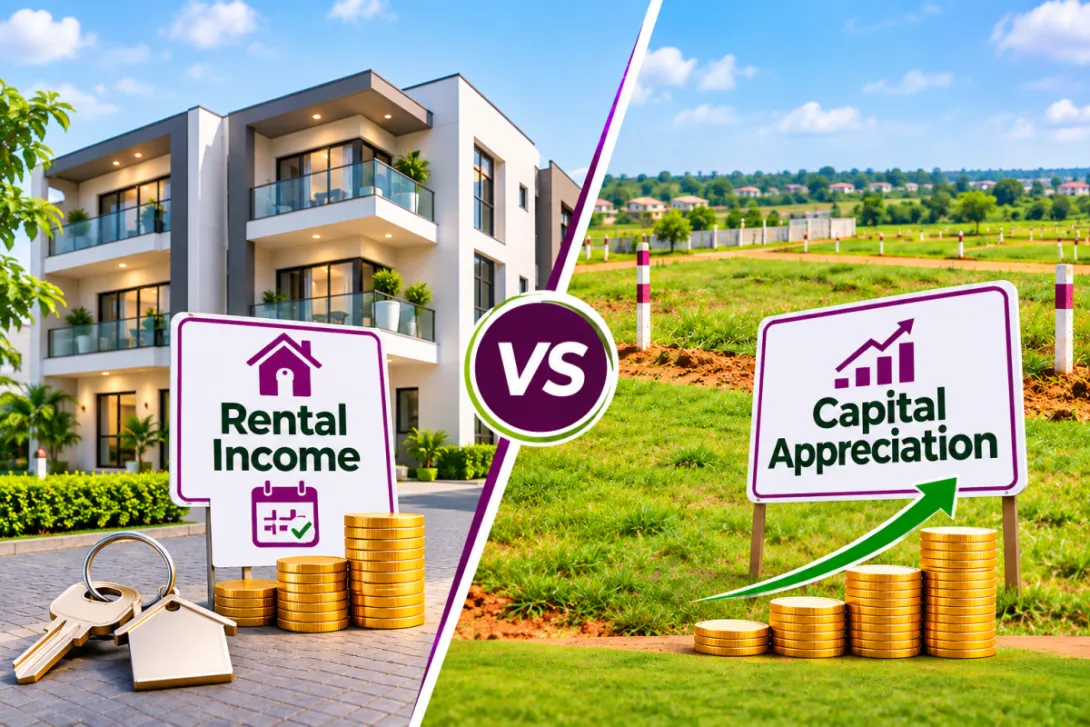
Real estate remains one of the investment options many Nigerians consider when building long term wealth. From buying residential apartments in Lagos and Abuja to acquiring land in emerging locations, property investment offers different ways to generate returns.
However, before investing in a property, an important question arises: should you buy property to earn regular rental income or invest in a property that is likely to increase in value over time?
Some investors prefer buying houses and apartments that generate monthly or annual rent. Others acquire land or properties in developing locations, hold them for several years and sell when their market value increases.
Both strategies can be profitable, but they work differently. One provides recurring income, while the other focuses on increasing the value of your investment.
So, rental income vs capital appreciation: which property investment makes more money in Nigeria?
The answer depends on your investment objectives, available capital, location, property type, market conditions and how long you intend to hold the property.
In this guide, we explain the difference between rental income and capital appreciation, how to calculate your potential returns, the advantages and disadvantages of each strategy, and how to decide which property investment approach is suitable for you.
1. What Is Rental Income in Real Estate Investment?
Rental income is the money a property owner receives from allowing another person or organisation to occupy or use a property in exchange for payment.
For example, if you purchase a residential apartment in Lekki, Lagos, and rent it out for ₦5 million annually, the amount received from the tenant represents your rental income.
Rental income is one of the most common ways property investors generate recurring revenue from real estate.
Properties that can generate rental income include:
- Residential houses.
- Self contained apartments.
- Mini flats.
- Two and three bedroom apartments.
- Duplexes.
- Commercial buildings.
- Office spaces.
- Shops and retail units.
- Warehouses.
- Shortlet apartments.
The amount of rental income a property generates depends on several factors, including its location, condition, size, accessibility, facilities and demand from prospective tenants.
For example, a well maintained apartment in a location with strong rental demand may generate more income than a similar property in an area with limited demand.
How Does Rental Income Work?
The process is relatively straightforward.
You acquire a property, prepare it for occupation, find a suitable tenant and collect rent according to the agreed tenancy arrangement.
Depending on the property and rental agreement, rent may be paid monthly, quarterly or annually.
Your rental income can provide a recurring source of revenue while you continue to own the property.
However, it is important to understand that the rent collected is not necessarily your profit.
You must account for expenses such as:
- Property maintenance.
- Repairs and renovations.
- Agency and management fees.
- Insurance where applicable.
- Applicable taxes and statutory charges.
- Service charges paid by the landlord.
- Periods when the property is vacant.
- Other operating expenses.
After deducting these expenses, the amount remaining represents your net rental income.
2. What Is Capital Appreciation in Real Estate Investment?
Capital appreciation refers to an increase in the market value of a property over time.
For example, imagine purchasing a plot of land in an emerging area of Ibeju Lekki, Lagos, for ₦15 million.
After several years, increased development, improved infrastructure and growing demand may raise the property's market value to ₦30 million.
If you eventually sell the property for ₦30 million, your gross capital gain is ₦15 million, before deducting transaction expenses, applicable taxes and other costs.
This increase in value is known as capital appreciation.
Capital appreciation is an important consideration for investors who acquire property with the intention of holding it for several years before selling.
What Causes Property Values to Increase in Nigeria?
Several factors can influence property appreciation.
1. Infrastructure development
The construction or improvement of roads, bridges, drainage systems, electricity infrastructure and public transportation can make previously less accessible locations more attractive.
Improved accessibility may increase demand for residential and commercial properties.
2. Population growth
As cities expand and more people move into urban areas, demand for housing, commercial spaces and land may increase.
This can influence property prices in locations experiencing sustained population growth.
3. Commercial and economic development
The establishment of businesses, industrial facilities, educational institutions, hospitals and commercial centres can attract people and increase demand for nearby properties.
4. Limited land availability
In established locations where suitable land is becoming scarce, competition among buyers may contribute to increasing property values.
5. Neighbourhood development
A location that gradually develops from a relatively undeveloped area into an established residential neighbourhood may experience an increase in property demand and value.
However, capital appreciation is not guaranteed. Property values can remain stagnant or decline when demand weakens, infrastructure fails to materialise or the local economy deteriorates.
3. Rental Income vs Capital Appreciation: Understanding the Difference
Although rental income and capital appreciation are both ways to make money from real estate, they represent different forms of investment returns.
| Comparison | Rental Income | Capital Appreciation |
|---|---|---|
| Meaning | Money earned by renting out property | Increase in the market value of property |
| Main objective | Generate recurring income | Build wealth through increased property value |
| Income frequency | Monthly, quarterly or annually, depending on the tenancy | Generally realised when the property is sold |
| Common property types | Houses, apartments, offices and shops | Land, residential property and commercial property |
| Management requirements | Usually requires tenant and property management | May require relatively little day to day management |
| Main risks | Vacancy, defaulting tenants, repairs and maintenance | Market decline, poor location and slow development |
| Cash flow | Can provide recurring cash flow | Usually does not generate cash until the property is sold or refinanced |
| Investment horizon | Can provide income over many years | Often depends on a medium or long term holding period |
The important distinction is that rental income provides cash flow, while capital appreciation increases the value of the asset.
An investor who understands both can make better property investment decisions.
4. How Much Can You Make From Rental Income in Nigeria?
The rental income potential of a property depends heavily on its location, property type, purchase price and the level of demand from tenants.
A property in a well established neighbourhood may attract higher rent, but it may also require a significantly larger initial investment.
Consider the following hypothetical example.
Example: Investing in a Residential Apartment
Assume you purchase a two bedroom apartment in Lagos for ₦80 million.
You successfully rent it out for ₦5 million annually.
Your annual rental income is ₦5 million.
To calculate the gross rental yield:
Gross Rental Yield = (Annual Rental Income ÷ Property Purchase Price) × 100
Using the figures above:
₦5 million ÷ ₦80 million × 100 = 6.25%.
Your gross rental yield is therefore 6.25% annually.
However, this is not your actual profit.
Assume you spend ₦800,000 annually on maintenance, management and other operating expenses.
Your estimated net rental income becomes:
₦5 million minus ₦800,000 = ₦4.2 million.
Your net rental yield is:
₦4.2 million ÷ ₦80 million × 100 = 5.25%.
This example demonstrates why investors should look beyond the advertised rental price when evaluating a property.
A property generating ₦5 million in annual rent does not necessarily mean the owner makes ₦5 million in profit.
Factors That Influence Rental Income
Before purchasing a property for rental purposes, consider the following:
Location: Properties close to workplaces, schools, hospitals, commercial centres and transportation routes may attract stronger tenant demand.
Property type: The rental potential of a self contained apartment may differ significantly from that of a luxury duplex or commercial property.
Property condition: Well maintained properties with functional facilities are generally more attractive to tenants.
Accessibility: Good roads and access to public transportation can influence tenant preference.
Security: Tenants often consider the safety of the neighbourhood before renting a property.
Facilities: Reliable water supply, electricity arrangements, parking, drainage and other amenities can influence rental demand.
Market competition: An area with many similar vacant properties may experience pressure on rental prices.
5. How Much Can You Make From Capital Appreciation in Nigeria?
Capital appreciation can create substantial investment gains, particularly when a property is acquired at a reasonable price in a location that experiences genuine growth.
Unlike rental income, however, appreciation is not usually received as regular cash.
The investor generally realises the gain when the property is sold.
Consider another hypothetical example.
Example: Investing in Land for Capital Appreciation
Assume you purchase one plot of land in a developing area for ₦15 million.
You hold the property for five years.
At the end of the fifth year, comparable properties and market evidence indicate that your land is worth ₦30 million.
Your gross capital gain is:
₦30 million minus ₦15 million = ₦15 million.
Your gross return on investment is:
₦15 million ÷ ₦15 million × 100 = 100%.
This means the property's value has doubled over the five year period.
However, the actual profit will depend on the costs associated with acquiring, holding and selling the property.
These may include:
- Legal fees.
- Survey and documentation expenses.
- Registration and perfection costs.
- Applicable taxes and statutory charges.
- Security and maintenance expenses.
- Selling and agency fees.
You should also consider inflation. A property increasing in nominal value does not necessarily mean that its purchasing power has increased by the same amount.
Factors That Influence Capital Appreciation
1. Location and future development
A property in a developing area may appreciate if infrastructure, commercial activities and residential development increase over time.
2. Accessibility
Locations with improving road networks and transportation connections may become more attractive to buyers.
3. Demand and supply
Where demand for property increases faster than available supply, prices may rise.
4. Government policies and infrastructure projects
Government investment in roads, transportation and other infrastructure can influence property values. However, proposed projects should not be treated as guaranteed developments.
5. Neighbourhood growth
The arrival of businesses, schools, hospitals, shopping facilities and other essential services can make a location more attractive.
6. Title and documentation
Properties with clear, verifiable and transferable titles are generally more attractive to informed buyers.
A property with unresolved ownership disputes or defective documentation may be difficult to sell, even when its location appears attractive.
6. Rental Income vs Capital Appreciation: Which Makes More Money?
This is the central question for anyone considering real estate investment in Nigeria.
The truth is that neither strategy automatically makes more money.
Your returns depend on how much you invest, how much income the property generates, how much its value increases and the costs involved.
Consider this hypothetical comparison.
Investment A: Rental Income
You purchase an apartment for ₦80 million.
Annual rental income: ₦5 million.
Annual operating expenses: ₦800,000.
Net rental income: ₦4.2 million.
Over five years, assuming the rent and expenses remain unchanged and the property is occupied throughout:
₦4.2 million × 5 = ₦21 million.
Your estimated cumulative net rental income is ₦21 million.
This calculation excludes changes in rental prices, major repairs, taxes, financing costs and other potential expenses.
Investment B: Capital Appreciation
You purchase a plot of land for ₦15 million.
After five years, its estimated market value increases to ₦30 million.
Gross capital gain: ₦15 million.
Gross return: 100%.
This example shows that the rental property generates recurring income, while the land investment produces a gain through increased value.
However, these investments involve different amounts of capital, different property types and different risk profiles.
They should not be compared solely by looking at the final figures.
What If the Rental Property Also Appreciates?
An important point many property investors overlook is that rental income and capital appreciation are not mutually exclusive.
A residential property can generate rental income while increasing in market value.
For example, the ₦80 million apartment in our illustration may generate rental income over five years while its market value also increases.
The investor benefits from two potential sources of return:
- Net rental income received during ownership.
- Capital appreciation when the property is eventually sold.
This is known as a combination of income and capital growth.
For many long term property investors, this can be an attractive investment strategy.
7. Which Property Investment Is Better for Different Types of Investors?
The best real estate investment strategy depends on your financial objectives and investment circumstances.
Here is how the two approaches may suit different investors.
A. Investors Seeking Regular Cash Flow
If your objective is to generate recurring income, rental property may be more suitable.
For example, someone approaching retirement may prefer owning residential apartments that generate rental income to supplement other sources of income.
However, rental income is not guaranteed. Tenants may default, properties may remain vacant and maintenance expenses may reduce returns.
B. Investors Interested in Long Term Wealth Creation
If you have a longer investment horizon and do not need immediate cash flow, capital appreciation may be attractive.
You may consider acquiring land or property in locations with genuine development prospects and holding the investment for several years.
The important thing is to investigate the location, title, infrastructure and market demand before purchasing.
C. First Time Property Investors
First time investors should not rush into buying property simply because someone promises high rental returns or rapid appreciation.
Start by understanding your available capital, financial obligations, risk tolerance and investment objectives.
A smaller, properly verified investment may be more appropriate than committing all your savings to an expensive property.
D. Investors With Limited Time for Property Management
Rental properties require attention.
You may need to deal with tenants, repairs, rent collection, inspections and other management responsibilities.
If you have limited time, you may consider appointing a competent property manager, although management fees will reduce your net income.
Land banking may require less day to day management, but you must still protect the property, monitor its legal status and guard against encroachment or unauthorised occupation.
E. Investors Who Want Both Income and Capital Growth
If your capital allows it, you may consider acquiring a property that can generate rental income while also offering potential for appreciation.
For example, a residential apartment in a location with established rental demand and reasonable prospects for future development may provide both benefits.
The key is to assess the purchase price against the property's realistic rental potential and market value.
8. Best Locations for Rental Income and Capital Appreciation in Nigeria
Location is one of the most important factors influencing property investment returns.
However, the best location for rental income may not necessarily be the best location for capital appreciation.
A mature residential neighbourhood may have established tenant demand, while an emerging development corridor may offer potential for long term capital growth.
Lagos
Lagos has a large population, diverse economic activities and substantial demand for residential and commercial property.
Locations such as Lekki, Ajah, Ikeja, Yaba, Surulere, Ikoyi and Victoria Island have different property markets, tenant profiles and investment requirements.
For rental income: Investors may examine established residential and commercial locations where there is demonstrable demand from professionals, families, students and businesses.
For capital appreciation: Investors may investigate emerging locations with improving infrastructure, increasing development activity and genuine demand.
However, prices, rental yields and investment risks differ considerably between neighbourhoods.
Abuja
Abuja offers opportunities across residential, commercial and mixed use property markets.
Locations such as Wuse, Gwarinpa, Lugbe, Life Camp, Jabi and Katampe attract different categories of property buyers and tenants.
For rental income: Investors may consider locations close to employment centres, government institutions, commercial districts and established residential communities.
For capital appreciation: Emerging areas with improving infrastructure and increasing residential demand may offer opportunities for long term investors.
Port Harcourt
Port Harcourt has a significant commercial and industrial economy, with property demand influenced by business activities, employment and residential development.
Areas such as GRA, Peter Odili Road and other established residential neighbourhoods may attract different tenant categories.
Ogun State
Parts of Ogun State have attracted interest from buyers seeking residential, industrial and land investment opportunities.
Locations with improving road connections and proximity to Lagos may appeal to investors looking for more affordable property acquisition options.
However, buyers should carefully investigate land ownership, planning restrictions, infrastructure and actual development prospects.
Important Location Advice
Do not purchase land simply because an agent or developer describes an area as the next big investment destination.
Investigate:
- Existing road infrastructure.
- Actual development activity.
- Proximity to employment and commercial centres.
- Access to essential services.
- Government acquisition status.
- Flooding and environmental conditions.
- Property prices in comparable locations.
- Evidence of genuine buyer and tenant demand.
A location's future potential should be supported by evidence, not marketing promises.
9. Risks of Investing in Rental Properties
Although rental income can provide recurring revenue, property owners face several risks.
1. Vacancy Risk
A property may remain vacant for months between tenants.
During this period, the owner may receive no rental income but still incur maintenance, security and other expenses.
2. Tenant Default
Some tenants may delay payment or fail to meet their rental obligations.
This can affect the investor's cash flow.
3. Maintenance and Repair Costs
Properties require regular maintenance.
Plumbing problems, roof leaks, electrical faults, damaged fittings and other issues can reduce rental profits.
4. Property Management Challenges
Managing tenants and maintaining a property can be time consuming.
Where professional management is required, the associated fees must be included in the investment calculation.
5. Changes in Rental Demand
Economic conditions, changes in neighbourhood development and increased housing supply can influence the amount tenants are willing or able to pay.
How to reduce these risks:
- Choose locations with demonstrable rental demand.
- Inspect the property before purchasing.
- Prepare a realistic rental income estimate.
- Screen prospective tenants appropriately.
- Use clear tenancy agreements.
- Maintain the property regularly.
- Budget for vacancies and unexpected repairs.
Consider professional property management where necessary.
10. Risks of Investing for Capital Appreciation
Capital appreciation may offer attractive long term returns, but it is not without risk.
1. Buying in the Wrong Location
A property may fail to appreciate if the surrounding area experiences little development or demand.
2. Defective Land Title
A property with unresolved ownership issues may be difficult to sell or transfer.
This can result in financial losses and prolonged legal disputes.
3. Overpaying for Property
Buying land at an inflated price reduces the potential return on investment.
A location may have good prospects, but that does not mean every property offered there is worth its asking price.
4. Slow Infrastructure Development
A property may be marketed based on proposed roads, government projects or future commercial developments that are delayed or never completed.
5. Inflation and Market Changes
An increase in the property's nominal value does not automatically translate into an equivalent increase in real purchasing power.
How to reduce these risks:
- Verify the property's title before payment.
- Investigate the location physically.
- Compare prices of similar properties.
- Examine actual infrastructure and development.
- Avoid relying entirely on projected appreciation.
- Invest with a realistic holding period.
Maintain proper documentation.
11. How to Calculate Your Total Return on Property Investment
Before investing in any property, you should understand how to calculate the potential return.
Two important measures are rental yield and capital appreciation.
A. Gross Rental Yield
Gross rental yield measures annual rental income as a percentage of the property's purchase price.
Formula:
Gross Rental Yield = (Annual Rent ÷ Property Purchase Price) × 100.
Example:
Purchase price: ₦100 million.
Annual rent: ₦6 million.
Gross rental yield:
₦6 million ÷ ₦100 million × 100 = 6%.
B. Net Rental Yield
Net rental yield accounts for operating expenses.
Formula:
Net Rental Yield = (Annual Rental Income minus Annual Operating Expenses) ÷ Total Property Investment Cost × 100.
Example:
Annual rent: ₦6 million.
Annual operating expenses: ₦1 million.
Total investment cost: ₦100 million.
Net rental yield:
₦5 million ÷ ₦100 million × 100 = 5%.
For a more accurate calculation, include acquisition costs, professional fees, applicable taxes and other relevant expenses in the total investment cost.
C. Capital Appreciation
Capital appreciation measures the increase in a property's value.
Formula:
Capital Appreciation = Current Market Value minus Original Purchase Price.
Example:
Original purchase price: ₦20 million.
Current market value: ₦35 million.
Capital appreciation:
₦35 million minus ₦20 million = ₦15 million.
D. Capital Appreciation Percentage
Formula:
Capital Appreciation Percentage = (Increase in Property Value ÷ Original Purchase Price) × 100.
Using the example above:
₦15 million ÷ ₦20 million × 100 = 75%.
This represents a 75% increase in the property's nominal value.
It is important to remember that this is an unrealised gain until the property is sold. Actual profit will be lower after deducting relevant acquisition, holding and disposal costs.
12. Five Questions to Ask Before Choosing a Property Investment Strategy
Before deciding whether to invest for rental income or capital appreciation, ask yourself these questions.
1. Do I need regular income from this investment?
If you need recurring cash flow, rental property may be worth considering.
If you can afford to hold an investment without receiving regular income, capital appreciation may be an option.
2. How long can I afford to hold the property?
Some properties may require several years before meaningful appreciation becomes evident.
Your investment horizon should reflect your financial circumstances.
3. Can I manage tenants and property maintenance?
Rental property requires ongoing management.
Consider whether you have the time, resources and experience to handle these responsibilities.
4. Have I properly investigated the location and title?
Never invest based solely on projected rental income or claims about future appreciation.
Verify ownership, inspect the property and assess the market.
5. What is my expected return after expenses?
Calculate your net rental yield, likely holding costs and potential resale value.
A property with high advertised rent may still produce a poor return if its purchase price and operating expenses are excessive.
Final Verdict: Rental Income or Capital Appreciation, Which Is Better?
There is no single answer that applies to every property investor.
Rental income is generally more suitable for investors seeking recurring cash flow from properties that attract tenants.
Capital appreciation may be more attractive to investors who have a longer investment horizon and are willing to hold property while its market value potentially increases.
However, the strongest property investment opportunities are not always limited to one strategy.
A well selected residential or commercial property may generate rental income while also appreciating in value over time.
For investors who can afford the initial purchase price and ongoing costs, combining both strategies may provide an opportunity to build wealth while earning recurring income.
Ultimately, the best property investment is not necessarily the one with the highest advertised rental yield or the most exciting appreciation forecast.
It is the property that makes financial sense after considering its purchase price, location, title, rental demand, operating expenses, market conditions and long term prospects.
Invest With a Strategy, Not Just an Expectation.
At LandMall, we believe that successful property investment begins with informed decisions.
Whether you are looking for a house that can generate rental income, land with long term investment potential, a residential apartment or a commercial property, understanding the market is essential before committing your money.
Explore property opportunities, compare locations and make informed real estate decisions with LandMall.
LandMall — Find Your Property. Invest With Insight.