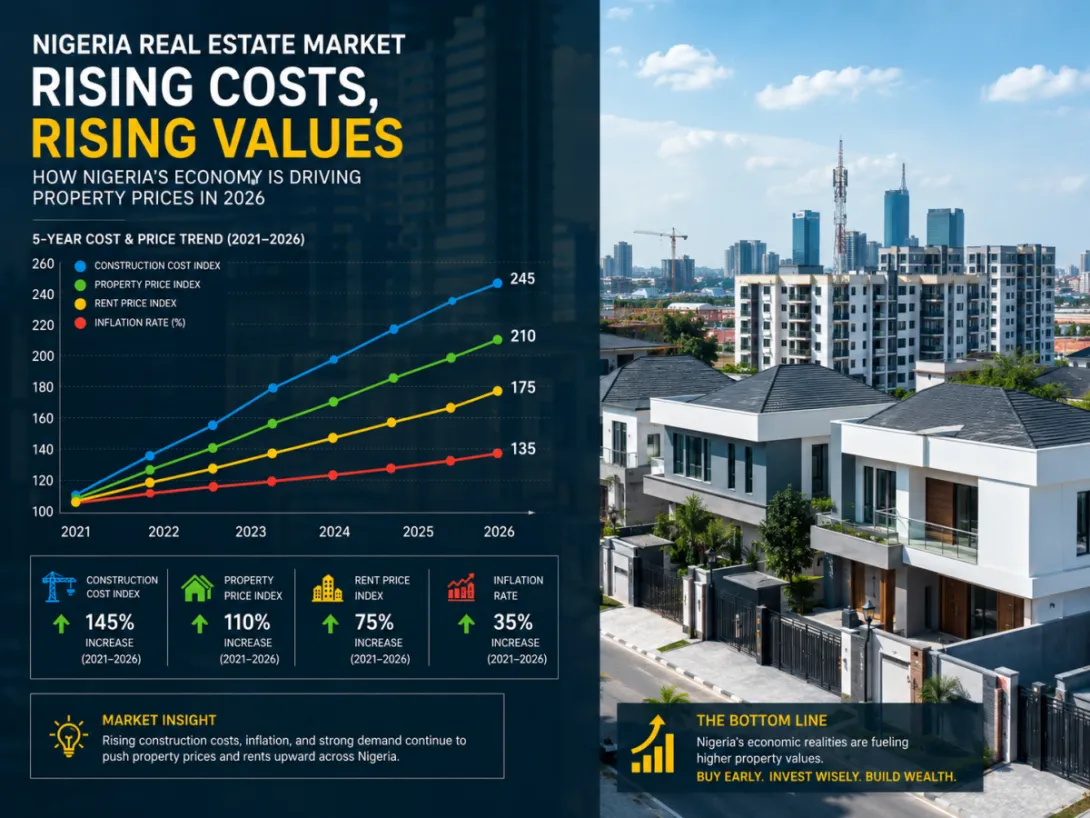
The Nigerian property market in 2026 is being shaped by one big reality: the economy is affecting almost every part of real estate pricing. Property values are no longer moving on location alone. They are now being pushed by inflation, exchange rate pressure, rising construction costs, financing constraints, compliance risk, and the continuing mismatch between housing demand and supply. Recent 2026 market outlooks describe Nigeria’s real estate sector as a market under pressure, with high inflation, FX volatility, elevated interest rates, and sharply rising construction costs pushing investors toward more disciplined and income focused decisions.
That is why understanding how Nigeria’s economy is affecting property prices in 2026 matters so much for buyers, renters, developers, and investors. A property may seem expensive on the surface, but in many cases the price reflects broader economic pressure, not just seller ambition. At the same time, Nigeria’s housing need remains very large. Official housing data released in January 2026 pegged the housing deficit at about 14.925 million units, while the Federal Ministry of Housing and Urban Development separately cited 15.2 million units as of 2025.
Inflation is still a major driver of property prices
One of the clearest links between the economy and the property market in Nigeria is inflation. Even where inflation has shown some easing from earlier peaks, the general price level remains high enough to affect land, building materials, labour, transport, and finishing costs. Reuters reported in April 2026 that inflation had dropped from the December 2024 peak of 33% to 15.06% in February 2026, but also noted that the Iran war had pushed petrol prices up by more than 50% and diesel prices up by more than 70%, putting new pressure on transport and industry. Reuters also reported in April 2026 that inflation accelerated again in March 2026, with higher transport and goods costs remaining a concern.
In practical terms, this means the cost of bringing a property to market remains high. Developers, landlords, and sellers are all dealing with higher operating and replacement costs, which feeds directly into property prices in Nigeria 2026. When the broader economy becomes more expensive, real estate rarely stays still.
Rising construction costs are pushing prices upward
Construction cost is one of the strongest channels through which the economy affects real estate. Recent Nigerian market analysis says sharply rising construction costs remain one of the defining features of the 2026 property market, alongside inflation and tighter financing conditions. BusinessDay’s real estate digest also says residential prices in well located urban corridors are expected to rise by about 5% to 15% annually, supported by infrastructure projects, population growth, and diaspora inflows.
This matters because every increase in cement, steel, transport, fuel, labour, and imported finishing materials affects replacement cost. If it costs more to build today, completed properties and new listings usually reflect that pressure. This is one reason construction costs in Nigeria are such a central part of real estate pricing in 2026.
Financing pressure is making supply more expensive
Another important factor is finance. The cost and availability of funding affect how much developers can build, how quickly they can deliver, and how much they must recover through sale or rent. Recent 2026 market commentary says tighter financing conditions are one of the core forces reshaping real estate investment in Nigeria. Reuters also reported in May 2026 that Nigeria is projected to spend about $11.6 billion, nearly half of government revenue, on debt service in 2026, highlighting how expensive capital and fiscal pressure remain in the broader economy.
For the real estate market, this means fewer easy projects, more phased developments, and greater pressure to price correctly from the start. High financing costs do not only affect big developers. They affect the final market because expensive money usually leads to expensive property.
Housing demand remains strong despite affordability pressure
A common misunderstanding is that if the economy is under pressure, real estate demand should disappear. That is not what Nigeria’s numbers suggest. The country still faces a massive housing deficit, and federal officials say around 550,000 new housing units are needed annually to make meaningful progress. That means housing demand in Nigeria remains structurally strong even when affordability is weak.
This creates an important market dynamic. Demand is there, but it is not evenly distributed. Buyers and renters still need homes, yet many are forced to downshift on size, location, or quality. That tension helps explain why prime areas may remain expensive, why rental pressure persists, and why affordable housing remains both a challenge and an opportunity.
The rental market is reflecting economic pressure too
The rental market in Nigeria is also reacting to the economy. Where buying becomes harder because mortgages are limited and property prices rise faster than incomes, more people remain in the rental market. That puts added pressure on rents. BusinessDay reporting in 2026 highlighted strong rent escalation in urban locations, while broader real estate outlooks continue to point to high rental demand as one of the clearest signs of market pressure.
For investors, this helps explain why income producing assets remain attractive. In a market with weak mortgage depth and strong demand for occupancy, rental property often becomes more appealing than speculative holding. That is another way the economy is shaping real estate investment in Nigeria in 2026.
Compliance and trust now affect pricing more than before
Property prices are not being driven only by macroeconomics. Trust and compliance are becoming more important price factors too. Lagos State’s publication of 176 illegal estates in 2026 showed that enforcement risk is no longer abstract, especially in fast growing corridors like Eti Osa, Ajah, Ibeju Lekki, and Epe. In parallel, BusinessDay argued in April 2026 that Nigeria’s real estate industry is dealing not only with a housing deficit, but also with a trust deficit that shapes how buyers and capital behave.
This means well documented, verifiable, and compliant properties are likely to command stronger confidence than questionable ones. In 2026, documentation quality can influence price resilience because buyers are more cautious and more aware of risk.
Prime areas are still staying expensive for a reason
Even under economic pressure, premium locations remain relevant because they offer a mix of prestige, limited supply, stronger rental demand, and better infrastructure appeal. BusinessDay’s digest says well located urban corridors are still expected to see annual price increases, and current market outlooks suggest the smart money is moving toward disciplined, high demand, income producing locations rather than random speculation.
That is why some parts of Lagos, Abuja, and other major urban centers continue to hold value better than weaker markets. In an unstable economy, buyers often become more selective, not less. That selectiveness tends to support better located and more trusted assets.
What this means for buyers and investors
For buyers, the lesson is that prices are being shaped by more than seller expectation. You have to look at replacement cost, rental demand, financing conditions, and land quality. For investors, the current market rewards realism. Properties with strong documentation, resilient demand, and income potential are better positioned than assets built only on hype. That conclusion is consistent with 2026 market reports showing a shift away from speculative land banking toward more cash flow focused and data driven investments.
Final Thoughts
So, how is Nigeria’s economy affecting property prices in 2026? It is doing so through inflation, rising construction costs, tighter financing conditions, stronger rental pressure, compliance sensitivity, and the continued shortage of quality housing supply. Even where inflation moderates at certain points, the broader cost environment remains high enough to keep real estate pricing under pressure.
The Nigerian real estate market is still active, but the rules are changing. In 2026, property prices are being shaped less by speculation alone and more by cost reality, trust, documentation, and actual demand. That is why anyone buying, renting, or investing needs to read the economy and the property market together.
If you want to make smarter property decisions in today’s market, start with the right insight.
LandMall helps buyers and investors access better property opportunities and supports clients with practical guidance across verification, planning, development, and project execution.
Call us today! +234 901 900 1191