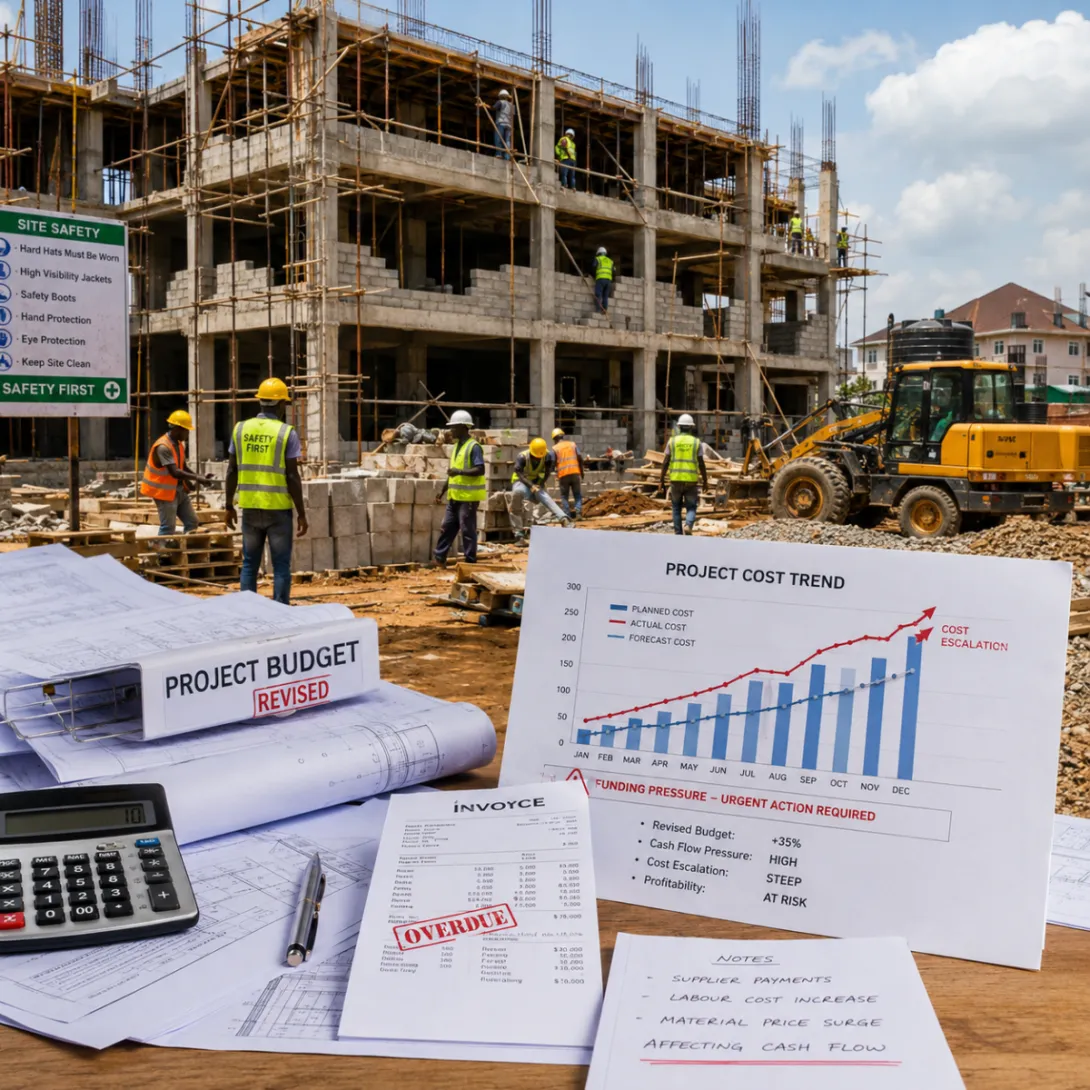
One of the biggest realities shaping construction projects in Nigeria today is financing pressure. Developers are not only dealing with rising material prices and execution risk. They are also dealing with the cost and availability of money itself. Across the sector, project funding has become harder to structure, more expensive to carry, and more dangerous to mismanage. Recent market reporting says Nigeria’s housing market continues to face the combined burden of high construction costs and tight monetary conditions, while industry commentary in 2026 points to tighter financing conditions across real estate.
This matters because construction is a cash flow business. Even where a project is viable on paper, weak financing can delay delivery, reduce quality, force redesign, slow procurement, or stop the project entirely. Federal housing officials have also said that financing housing construction is expensive, that mortgage support for end users remains a major challenge, and that high private sector financing costs push final prices upward.
Why Financing Pressure Has Become a Bigger Problem
Financing pressure in construction happens when the cost of funds, the timing of cash inflows, and the rising cost of project delivery no longer move in balance. In Nigeria, this has become more serious because developers are facing elevated building costs while also operating in a high interest rate environment. BusinessDay reported that rising construction costs and tight monetary policy were worsening housing sector stress, while another 2026 market outlook described elevated construction costs and tighter financing conditions as central features of the real estate market this year.
At the broader macro level, Nigeria is also under debt cost pressure. Reuters reported on May 13, 2026 that Nigeria is projected to spend about $11.6 billion, nearly half of government revenue, on debt payments in 2026, crowding out spending on development priorities. That wider funding strain matters because it affects infrastructure support, public finance flexibility, and the overall cost environment for long term investment.
1. Higher Borrowing Costs Make Projects Harder to Start
A major effect of financing pressure is that projects that once looked feasible become difficult to start. When the cost of borrowing is high, developers need stronger margins, faster sales, or more equity just to make the numbers work. Federal housing officials have openly acknowledged that the cost of funds is a major macroeconomic issue and that commercial mortgage rates are so high that affordability is affected.
This affects more than homebuyers. It affects developers too. If construction finance is expensive, the developer either passes the cost into the final selling price, reduces project scope, phases construction, or postpones the project. The ministry has also said that high private sector construction financing drives up prices because developers are servicing double digit loans.
2. Rising Material Costs Make Financing Riskier
Financing pressure becomes even worse when project costs are unstable. If materials keep rising while a project is being funded with borrowed money, the original budget can become outdated quickly. Developers then face a double problem. The project is more expensive, and the money used to fund it is also more expensive.
Recent sector reporting linked high interest rates with surging construction costs as a major factor worsening Nigeria’s housing crisis. Developers speaking at a 2026 industry event also said they were responding to price pressure with fixed price supply contracts, value engineering, and constant communication with buyers.
This is why financing pressure is not separate from cost pressure. In practice, they reinforce each other.
3. Slower Sales and Weak Mortgage Access Create Cash Flow Problems
Many construction projects in Nigeria depend on buyer deposits, off taker commitments, staged payments, or expected mortgage backed purchases. When mortgage access is weak and consumer affordability is low, that cash flow becomes less reliable.
A March 2026 real estate digest published by BusinessDay said mortgage penetration in Nigeria remains below 1 percent of GDP and that, with interest rates in the mid 20 percent range, most home purchases are still funded through personal savings or informal financing. The same publication noted that construction costs have added to the strain.
This means many developers cannot rely on broad mortgage demand to absorb completed stock quickly. If buyers are slower to pay and end user financing remains limited, the developer’s repayment pressure increases. That can slow work on site, delay finishing, or make the project harder to complete smoothly.
4. More Projects Need Phasing or Redesign
Because of financing pressure, more developers are adjusting the way they build. Instead of one large continuous project, they phase delivery, redesign units, simplify finishes, or cut non essential features. This is no longer just a design choice. It is a financing response.
Industry reporting in early 2026 said developers were using value engineering and fixed price supply strategies to cope with current market pressure. A 2026 market outlook also described the sector as moving toward more structured, data driven, and practical investment decisions because of high costs and tighter financing.
In real terms, this means financing pressure is changing not only whether projects happen, but how they are conceived and delivered.
5. Public Support Alone Cannot Close the Gap
Financing pressure is also a sector wide challenge because public funding is not enough to solve Nigeria’s housing needs by itself. Federal housing statements indicate that current annual public housing budgets are far below what would be required to tackle the housing deficit at scale. One ministry statement said the current sub ₦100 billion annual budget for housing is inadequate compared with roughly ₦5.5 trillion needed annually to address the deficit.
That gap helps explain why public private partnerships, off taker guarantees, innovative funding structures, and new financing instruments are being discussed so often. The ministry has said traditional financing models are no longer enough and that instruments like mortgage backed securities, digital finance, microfinance, and PPP structures need to play a bigger role.
6. Developers Are Under Pressure to De Risk Projects
Because finance is harder to secure and more expensive to hold, developers now need stronger risk controls. That includes better feasibility studies, tighter land verification, clearer procurement planning, stronger presales strategy, and closer cost monitoring.
This is also why de risking tools matter. In a July 2025 interview, the Federal Mortgage Bank of Nigeria said it was providing off taker guarantees and construction financing support to help unlock private sector housing projects, with over ₦100 billion committed in guarantees for Renewed Hope Cities and Estates.
That tells you something important about the current market. Developers increasingly need structured support and risk sharing to make projects bankable.
7. Financing Pressure Ultimately Affects Buyers Too
Although this is often discussed as a developer problem, financing pressure eventually shows up in the final price, delivery speed, and affordability of housing. If the developer is borrowing at high cost and building with expensive materials, the end user will usually feel it through higher prices, slower delivery, or reduced product quality.
Federal housing commentary has repeatedly linked funding constraints, high construction costs, expensive mortgages, and affordability challenges. That means the pressure is not isolated inside boardrooms. It flows through the entire housing value chain.
What Developers Should Be Paying Attention To
In the current market, developers need to pay closer attention to:
Project cash flow timing
Realistic sales absorption rates
Borrowing cost sensitivity
Material price volatility
Phasing options
Alternative funding structures
Buyer affordability
These are practical conclusions drawn from the current market environment described by official housing sources and recent sector reporting.
Final Thoughts
So, how is financing pressure affecting construction projects in Nigeria? It is making projects harder to start, harder to sustain, and harder to price. High borrowing costs, weak mortgage depth, rising material prices, and tighter cash flow conditions are forcing developers to rethink budgets, redesign products, phase delivery, and manage risk more carefully than before.
Construction is still happening, but the market now rewards discipline more than optimism. Developers who understand funding structure, cost control, and project timing are in a better position to survive current pressure and still deliver viable projects.
If you are planning a development project, financing should not be an afterthought.
LandMall helps investors and developers access better property opportunities, while Brick Fort, LandMall’s trusted partner, supports clients with practical guidance across planning, development, and project execution.
Call or WhatsApp +234 901 900 1191 or +234 808 668 2070 to get started.