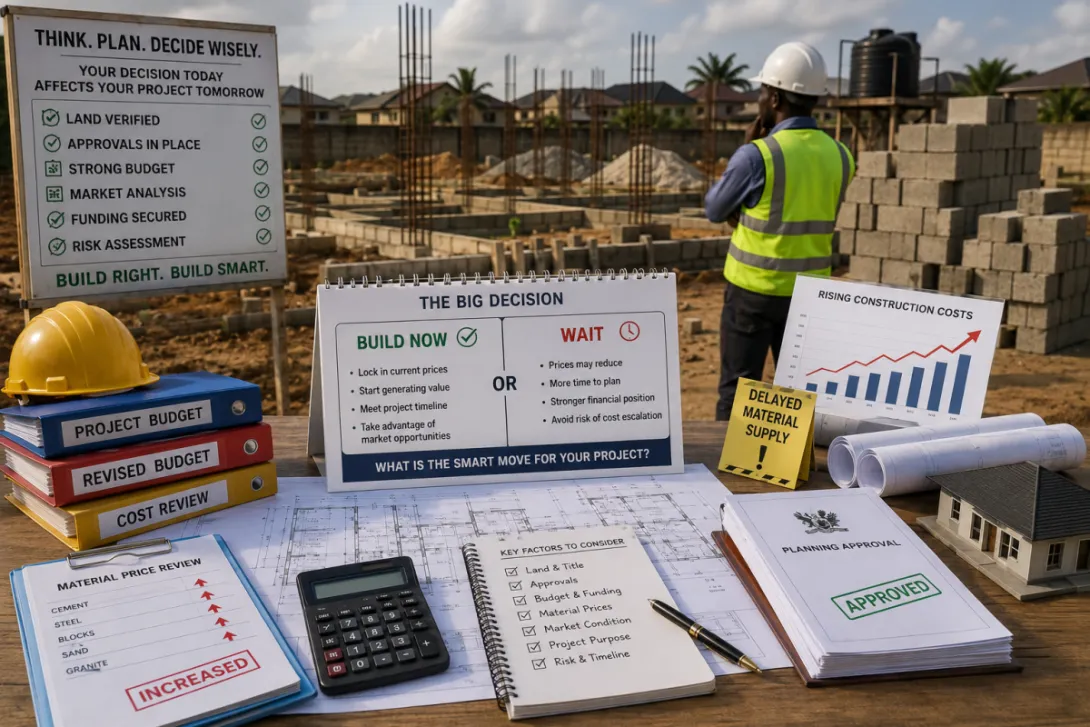
For many developers, landowners, and first time builders, one of the biggest questions in today’s market is whether to start construction now or hold off. That question has become more difficult because construction in Nigeria in 2026 is shaped by rising material costs, tighter financing conditions, compliance pressure, and slower affordability on the demand side. Recent market reporting says Nigeria’s real estate sector in 2026 is being shaped by elevated construction costs and tighter financing conditions, while the wider economy is still dealing with the effects of reforms that have driven a severe cost of living squeeze.
The truth is that there is no one answer for everybody. The right decision depends on your land status, funding strength, project goal, timeline, and ability to manage current market pressure. In other words, deciding whether to build now or wait is less about emotion and more about structure. In Lagos especially, this matters even more because the state has publicly listed 176 illegal estates and given developers deadlines to regularize approvals, which shows that land and compliance mistakes are being taken more seriously.
Start With the Real Reason You Want to Build
Before you think about cement, iron rods, or labour, be clear about why you want to build. Are you building for personal use, rental income, resale, phased development, or land banking with gradual improvement? That goal matters because a project meant for immediate use may justify starting sooner, while a speculative project with weak funding may be safer to delay until conditions improve. Nigeria still has a very large housing need, so the long term demand case for real estate remains strong, but that does not automatically mean every project should begin immediately. Official housing data released in January 2026 put the housing deficit at about 14.93 million units, while the ministry has separately cited 15.2 million units for 2025.
If Your Land Is Not Fully Verified, Waiting Is Smarter
One of the clearest signs that you should not build yet is uncertainty around the land itself. If title is unclear, the survey has not been checked properly, approvals are pending, or there is any acquisition or regularization issue, it is usually smarter to wait and resolve that first. In today’s market, land verification matters more because enforcement risk is more visible and expensive than before. The Federal Ministry of Housing and Urban Development has emphasized the need for land to be secure, titled, documented, and verifiable, while Lagos has made it clear through recent enforcement that undocumented or irregular development carries real risk.
So if you are asking when to start building in Nigeria, one practical answer is this: do not start construction on land you have not fully verified. Building on the wrong land can cost far more than the structure itself once stoppage, redesign, or legal conflict begins.
If Your Funding Is Weak or Unstable, Waiting May Protect You
A second major factor is finance. Construction is easier to start than to sustain, and many projects run into trouble not because the idea was bad, but because the cash flow was too weak for the current market. High borrowing costs and tighter financing conditions are major realities in Nigeria in 2026. Reuters reported in May 2026 that Nigeria is projected to spend about $11.6 billion, nearly half of government revenue, on debt service this year, highlighting the broader pressure around capital costs and long term finance. BusinessDay also says elevated construction costs and tighter financing conditions are shaping the property market in 2026.
If your project depends on uncertain borrowing, expected sales that are not yet secure, or cash that may not come in on time, waiting may be wiser than starting and stalling midway. A half finished project in a volatile market is often more dangerous than a delayed project with a stronger funding plan. Federal housing officials have also said financing housing construction is expensive, and the government has been pushing for more creative funding structures because traditional models are not enough.
If You Can Build in Phases, Starting Now May Still Make Sense
Waiting is not always the best option. If your land is clean, your approvals are in order, and you have enough money to complete a meaningful phase of the work without distress, starting now can still make sense. Many developers in the current market are not abandoning projects entirely. They are phasing them, simplifying scope, and using value engineering to stay in motion while controlling risk. BusinessDay’s 2026 market outlook points to a more structured and strategic market, not a dead one.
This means the decision does not always have to be “build everything now” or “build nothing now.” Sometimes the smarter answer is to start with site preparation, fencing, approvals, foundation, or a first deliverable block while keeping the later stages flexible. That approach reduces exposure to future shocks and helps you keep momentum without overcommitting.
Material Costs Matter, But They Are Not the Only Issue
A lot of people delay construction simply because material prices are high. That concern is valid. Recent reporting says rising prices for cement, steel, and other inputs are slowing real estate development in Nigeria, while the federal ministry is pushing local building materials hubs specifically to reduce construction costs.
But material cost alone should not make the decision for you. If you wait, prices may ease, but they may also rise further, especially where imported content, energy costs, and currency pressure are involved. Reuters reported in April 2026 that Nigeria plans to cut import duties on construction materials from July 1, 2026 to lower input costs, which could help some projects, but it does not guarantee that all construction costs will fall materially or stay low.
So the real question is not just whether materials are expensive. It is whether your project can absorb current costs with enough contingency and discipline to avoid distress.
Approvals and Compliance Can Decide the Timing
Another strong reason to wait is when your planning path is not ready. If layout approval, building permit, development permit, or construction commencement approval is still unresolved, it is usually better to pause than to rush into non compliant work. In Lagos, official systems exist for physical planning applications, and building control guidance makes clear that commencement approval follows development permit.
This matters because a project that starts without proper approval may face stop work action, penalties, or forced redesign later. In today’s market, compliance is not a minor issue. It is part of project viability.
Questions That Help You Decide
A practical way to decide whether to build now or wait is to ask yourself a few honest questions. Is the land fully verified? Are approvals in place or close to completion? Can you fund a meaningful phase without panic? Can the project survive current cost levels? Are you building for immediate need or just reacting to fear that prices may rise later? Are you prepared to supervise quality and procurement carefully in a tight market?
If most of those answers are weak, waiting is probably smarter. If most are strong, and your project is well structured, starting now may be reasonable even in a difficult market. Current market conditions in Nigeria reward planning, patience, and structure far more than speed alone.
Final Thoughts
So, how do you decide whether to build now or wait? You decide by looking at five things clearly: land status, approvals, funding strength, cost resilience, and project purpose. If those are in order, building now can still work, especially in phases. If they are not, waiting can save you from a much bigger problem later. In Nigeria’s 2026 construction market, discipline is more important than urgency.
The best projects today are not always the fastest ones. They are the ones that start on verified land, with realistic budgets, proper approvals, and a funding structure strong enough to survive the market. That is what makes the difference between progress and regret.
If you are trying to decide whether to build now or wait, start with proper land, planning, and project review.
LandMall helps investors and property owners access better property opportunities, while Brick Fort, LandMall’s trusted partner, supports clients with practical guidance across verification, planning, development, and project execution.
Call or WhatsApp +234 901 900 1191 or +234 808 668 2070 to get started.