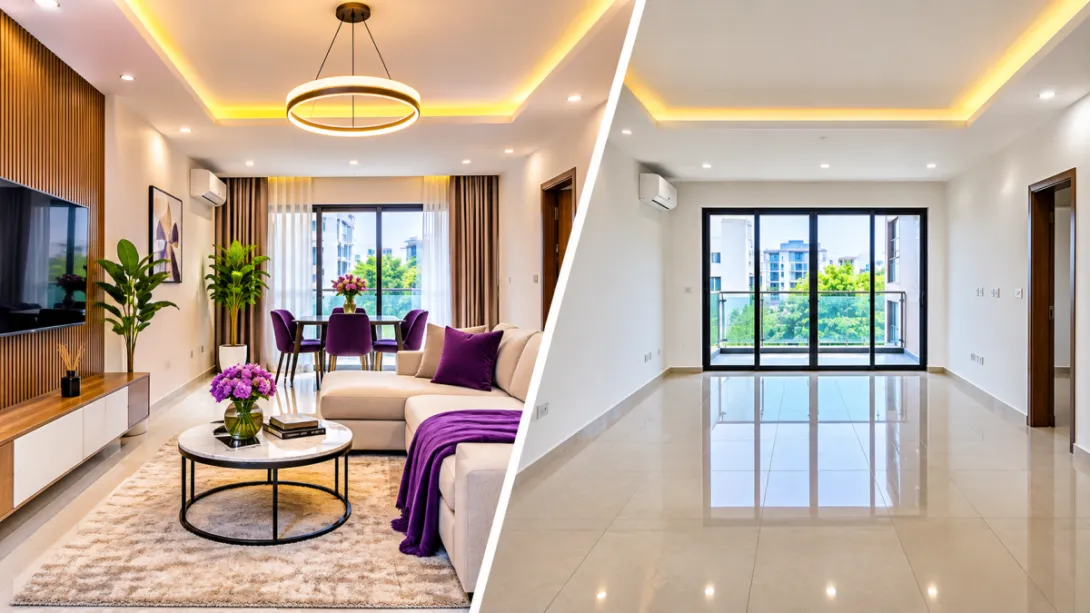
When investing in residential real estate in Nigeria, choosing the right property is only part of the decision. Another important question is whether to rent it out furnished or unfurnished.
Some property investors prefer furnished apartments because they can attract professionals, expatriates, corporate tenants and shortlet guests who are willing to pay for convenience. Others prefer unfurnished apartments because they generally require less initial investment in furniture, appliances and interior fittings.
Both options can generate rental income, but they have different financial implications, management requirements and investment risks.
For example, a fully furnished two bedroom apartment in Lekki, Lagos, may command a higher rental price than a comparable unfurnished apartment. However, the landlord must spend money on furniture, appliances, maintenance and eventual replacement of damaged items.
On the other hand, an unfurnished apartment may attract tenants who prefer to bring their own furniture and settle into a property for a longer period. Although the rental income may be lower, the landlord may have fewer furnishing and replacement expenses.
So, furnished vs unfurnished apartments: which should you invest in?
The answer depends on your investment objectives, location, available capital, target tenants, expected rental income and willingness to manage the property.
In this guide, we examine the differences between furnished and unfurnished apartments, their advantages and disadvantages, rental income potential, investment costs and the factors to consider before making a decision.
1. What Is a Furnished Apartment?
A furnished apartment is a residential property that comes with furniture, appliances and other essential household items required for comfortable occupation.
Instead of moving into an empty apartment and purchasing everything independently, tenants can occupy a furnished property with most of the necessary household facilities already provided.
Depending on the property category, a furnished apartment may include:
- Beds and mattresses.
- Wardrobes and storage cabinets.
- Sofas and living room furniture.
- Dining tables and chairs.
- Refrigerators and freezers.
- Cookers and microwaves.
- Washing machines.
- Air conditioning units.
- Televisions.
- Curtains and window blinds.
- Kitchen utensils and appliances.
- Water heaters.
- Internet connectivity.
- Decorative fittings and accessories.
The level of furnishing varies from one property to another.
A basic furnished apartment may contain essential furniture and appliances, while a luxury furnished apartment may include premium interior finishes, modern appliances, entertainment facilities and professionally designed living spaces.
Who Typically Rents Furnished Apartments?
Furnished apartments may appeal to:
- Corporate executives on temporary assignments.
- Expatriates working in Nigeria.
- Professionals relocating to a new city.
- Consultants and contractors working on short term projects.
- Individuals travelling for business.
- Families requiring temporary accommodation.
- Tourists and visitors.
- Tenants who prefer convenience and do not want to purchase furniture.
In cities such as Lagos and Abuja, furnished apartments may attract tenants who value convenience, location and ready to occupy accommodation.
2. What Is an Unfurnished Apartment?
An unfurnished apartment is a residential property that is offered for rent without the major furniture and household appliances normally required for everyday living.
The property may still have essential fixtures such as kitchen cabinets, wardrobes, bathroom fittings, electrical installations, plumbing facilities and other permanent fittings.
However, the tenant is generally expected to provide personal furniture, appliances and household items.
An unfurnished apartment may include:
- Bedrooms without beds or mattresses.
- Living rooms without sofas.
- Kitchens without movable appliances.
- Dining areas without tables and chairs.
- Bathrooms with permanent sanitary fittings.
- Built in wardrobes and kitchen cabinets, where provided.
- Basic electrical and plumbing installations.
The exact condition of an unfurnished apartment should always be confirmed during inspection.
Who Typically Rents Unfurnished Apartments?
Unfurnished apartments may attract:
- Families planning to live in a property for several years.
- Professionals with existing household furniture.
- Long term tenants.
- Individuals relocating permanently.
- Tenants who prefer choosing their own furniture and interior design.
- People seeking more affordable rental accommodation.
For landlords, unfurnished apartments can be attractive because tenants generally take responsibility for providing their movable household furniture and appliances.
3. Furnished vs Unfurnished Apartments: What Is the Difference?
Although both property types serve residential accommodation needs, they differ in cost, tenant expectations, management requirements and potential rental income.
| Comparison | Furnished Apartment | Unfurnished Apartment |
|---|---|---|
| Initial investment | Generally higher due to furniture and appliances | Generally lower |
| Rental price | May command higher rent | Usually priced lower than comparable furnished units |
| Target tenants | Professionals, corporate tenants, expatriates and temporary residents | Families, long term tenants and individuals with existing furniture |
| Maintenance | Furniture and appliances require attention | Generally fewer movable items to maintain |
| Tenant convenience | Ready for occupation | Tenant provides most personal household items |
| Management requirements | Can be more demanding | Often relatively straightforward |
| Replacement costs | Landlord replaces worn or damaged items where responsible | Fewer furniture replacement expenses |
| Potential rental arrangement | Annual, medium term or shortlet, depending on the property | Commonly annual or longer term |
| Vacancy considerations | Depends on location, pricing and demand | Depends on location, pricing and demand |
| Investment strategy | Convenience and potentially higher rental income | Lower furnishing costs and potentially simpler management |
The most important point is that a furnished apartment does not automatically generate more profit than an unfurnished apartment.
You must compare the additional rental income against the cost of furnishing, maintaining and managing the property.
4. Advantages of Investing in Furnished Apartments
Furnished apartments can offer several benefits to property investors, particularly in locations where there is strong demand for ready to occupy accommodation.
A. Potential for Higher Rental Income
One of the main attractions of furnished apartments is the possibility of earning higher rent than comparable unfurnished properties.
Tenants may be willing to pay more for a property that already provides furniture, appliances and essential household facilities.
For example, a furnished two bedroom apartment in a suitable location may command a higher rental price than a similar unfurnished apartment.
However, the difference depends on the neighbourhood, quality of furnishing, property condition and target market.
B. Access to Corporate and Professional Tenants
Furnished apartments can appeal to companies seeking accommodation for employees, consultants and visiting executives.
Some organisations prefer ready to occupy apartments because they reduce the inconvenience and expense associated with purchasing furniture for temporary staff accommodation.
This creates opportunities for landlords who position their properties to serve the corporate rental market.
C. Opportunities in the Shortlet Market
A furnished apartment can also be operated as a shortlet, subject to applicable regulations, estate rules and other relevant requirements.
Shortlet accommodation may generate income through daily, weekly or monthly bookings.
This can be attractive in locations with demand from business travellers, tourists, visiting professionals and individuals requiring temporary accommodation.
However, shortlet investment involves a different business model from traditional annual rentals.
It requires active marketing, booking management, cleaning, guest communication, utilities management and regular maintenance.
Higher advertised nightly rates do not automatically translate into higher annual profits.
D. Competitive Advantage
A well furnished apartment may stand out in a competitive rental market.
Where prospective tenants have several properties to choose from, a professionally furnished apartment with functional appliances and attractive interiors may have an advantage.
E. Convenience for Tenants
Many tenants prefer moving into a property without having to purchase beds, sofas, refrigerators, cookers and other household items.
This convenience may be particularly attractive to people relocating for work or staying in a city temporarily.
5. Disadvantages of Investing in Furnished Apartments
Despite the potential benefits, furnished apartments also come with additional responsibilities and expenses.
A. Higher Initial Investment
Furnishing an apartment requires additional capital.
You may need to purchase beds, mattresses, sofas, dining furniture, appliances, curtains, kitchen equipment and other household items.
For luxury apartments, interior design and premium fittings can significantly increase the initial investment.
B. Furniture and Appliance Maintenance
Furniture and appliances experience wear and tear.
Air conditioners require servicing, washing machines may develop faults, refrigerators may need repairs and mattresses eventually require replacement.
These expenses must be included in your rental investment calculations.
C. Risk of Damage
Some tenants may not take adequate care of furniture and household appliances.
Items may become damaged through misuse, negligence or ordinary wear and tear.
Landlords should prepare a detailed inventory and document the condition of every item before handing over the apartment.
D. Higher Management Requirements
Furnished apartments may require more attention than unfurnished properties.
Where the apartment is operated as a shortlet, management responsibilities increase significantly.
The landlord may need to coordinate cleaning, linen replacement, appliance servicing, guest check in and check out, and regular inspections.
E. Changing Interior Design Preferences
Furniture and interior styles can become outdated.
An apartment that looks attractive today may require refurbishment after several years to remain competitive.
Landlords should therefore budget for periodic upgrades.
6. Advantages of Investing in Unfurnished Apartments
Unfurnished apartments remain an attractive option for many residential property investors.
They may be particularly suitable for landlords seeking relatively straightforward rental arrangements.
A. Lower Initial Investment
One major advantage is that landlords do not need to spend substantial additional money furnishing the apartment.
The property can be prepared for occupation with essential fixtures and functional facilities.
This may reduce the amount of capital required to start earning rental income.
B. Fewer Furniture Replacement Expenses
Because tenants provide most of their movable furniture and appliances, landlords generally have fewer household items to maintain or replace.
The landlord must still attend to applicable structural and property maintenance responsibilities, but the absence of landlord supplied furniture can simplify management.
C. Potentially Longer Tenancy Periods
Unfurnished apartments may appeal to families and individuals who intend to establish a permanent or long term residence.
Such tenants may be less interested in relocating frequently because they have invested in furnishing the property themselves.
However, long tenancy periods are not guaranteed and depend on tenant circumstances, location and rental arrangements.
D. Simpler Property Management
Unfurnished apartments may be easier to manage because there are fewer movable household items to inspect, maintain and replace.
This can be useful for landlords who own several properties or live far away from their rental investments.
E. A Wider Range of Residential Tenants
Unfurnished apartments can appeal to different categories of tenants, particularly people who already own household furniture.
Depending on the location and rental price, this may provide access to a broad residential rental market.
7. Disadvantages of Investing in Unfurnished Apartments
Although unfurnished apartments may require less initial investment, they also have limitations.
A. Potentially Lower Rental Income
An unfurnished apartment may command less rent than a comparable furnished apartment because the tenant is expected to provide personal furniture and appliances.
The difference, however, varies by location and market conditions.
B. Limited Appeal to Temporary Residents
Professionals relocating temporarily, expatriates and corporate visitors may prefer furnished accommodation.
An unfurnished apartment may therefore be less attractive to these categories of tenants.
C. Tenant Fit Out Requirements
Some tenants may request permission to install additional fittings, make minor alterations or customise parts of the property.
Landlords should establish clear rules governing alterations, installations and restoration obligations.
D. Competition From Furnished Apartments
In locations where furnished accommodation is in high demand, an unfurnished apartment may face competition from properties offering ready to occupy facilities.
The landlord may need to compete through pricing, location, property condition and other features.
8. How Much Can You Make From Furnished vs Unfurnished Apartments?
To determine which investment makes more money, you must compare the total investment cost with the expected net rental income.
Let us consider a hypothetical example involving two similar two bedroom apartments in the same neighbourhood.
Investment A: Unfurnished Apartment
Purchase price: ₦100 million.
Annual rent: ₦5 million.
Estimated annual operating expenses: ₦500,000.
Net rental income:
₦5 million minus ₦500,000 = ₦4.5 million.
Net rental yield:
₦4.5 million ÷ ₦100 million × 100 = 4.5%.
Investment B: Furnished Apartment
Purchase price: ₦100 million.
Furniture and appliances: ₦8 million.
Total investment cost: ₦108 million.
Annual rent: ₦7 million.
Estimated annual operating expenses: ₦1.2 million.
Net rental income:
₦7 million minus ₦1.2 million = ₦5.8 million.
Net rental yield:
₦5.8 million ÷ ₦108 million × 100 = approximately 5.37%.
Comparing the Two Investments
| Financial Details | Unfurnished | Furnished |
|---|---|---|
| Property purchase price | ₦100M | ₦100M |
| Furnishing cost | Nil | ₦8M |
| Total investment | ₦100M | ₦108M |
| Annual rental income | ₦5M | ₦7M |
| Annual operating expenses | ₦500K | ₦1.2M |
| Net annual rental income | ₦4.5M | ₦5.8M |
| Net rental yield | 4.5% | 5.37% |
Based on these assumptions, the furnished apartment generates a higher net rental yield.
However, the difference is not necessarily enough to make furnishing the better investment in every situation.
The landlord must also consider furniture depreciation, replacement costs, vacancy periods, taxes, financing expenses and other costs not included in this illustration.
The figures are hypothetical and do not represent guaranteed rental returns in any Nigerian location.
The lesson: Higher rental income does not automatically mean higher profitability. Always calculate the net return on your total investment.
9. Furnished Apartments vs Unfurnished Apartments: Which Is Better for Lagos?
Location plays an important role in determining whether a furnished or unfurnished apartment is more suitable.
Lagos has a diverse rental market serving families, professionals, corporate organisations, expatriates, students and temporary visitors.
Different neighbourhoods attract different tenant categories.
Lekki and Ajah
Lekki and Ajah attract a range of residential tenants, including professionals, families and people working within the Lekki corridor.
Furnished apartments may appeal to professionals and temporary residents who want convenient accommodation.
Unfurnished apartments may attract families and individuals seeking longer term residential accommodation.
Victoria Island and Ikoyi
Victoria Island and Ikoyi have established corporate and premium residential markets.
Furnished apartments may appeal to expatriates, executives, corporate visitors and professionals requiring ready to occupy accommodation.
Unfurnished apartments may also perform well among tenants who prefer to establish their own homes.
The quality, location and rental price of the property will influence its competitiveness.
Ikeja
Ikeja serves a mixture of residential and commercial demand.
Its proximity to business districts, transportation routes, government offices and commercial centres can make both furnished and unfurnished apartments attractive.
Yaba and Surulere
These locations have diverse residential markets, including students, professionals, families and business owners.
The appropriate investment strategy will depend on the specific neighbourhood, property type and tenant demand.
10. What About Furnished and Unfurnished Apartments in Abuja?
Abuja also presents opportunities for both furnished and unfurnished residential property investment.
The city has a substantial population of government workers, professionals, corporate employees, expatriates and individuals relocating for employment or business.
Locations such as Wuse, Gwarinpa, Jabi, Life Camp, Katampe and Lugbe have different rental markets and tenant profiles.
When Furnished Apartments May Be Attractive
Furnished apartments may appeal to:
- Corporate visitors.
- Government contractors.
- Consultants.
- Expatriates.
- Professionals on temporary assignments.
- Families requiring temporary accommodation.
When Unfurnished Apartments May Be Attractive
Unfurnished apartments may appeal to:
- Families seeking long term accommodation.
- Government employees.
- Professionals relocating permanently.
- Individuals with existing household furniture.
Investors should compare actual rental demand, property prices and operating expenses before choosing either strategy.
11. Should You Convert an Unfurnished Apartment Into a Furnished Apartment?
If you already own an unfurnished apartment, you may be considering whether furnishing it will increase your rental income.
This can be a worthwhile decision, but it should be based on market evidence rather than assumptions.
Before furnishing your property, consider the following.
A. Research Demand for Furnished Apartments
Find out whether prospective tenants in the neighbourhood actively search for furnished accommodation.
Speak with reputable property consultants and examine comparable furnished listings.
B. Calculate the Additional Rental Income
Determine how much extra rent the furnished apartment can realistically command.
For example, if an unfurnished apartment generates ₦5 million annually while a comparable furnished apartment generates ₦6.5 million, the additional gross rental income is ₦1.5 million annually.
C. Calculate the Cost of Furnishing
Obtain realistic quotations for furniture, appliances, interior fittings and installation.
Do not underestimate the cost of quality items.
D. Estimate Maintenance and Replacement Expenses
Consider the cost of servicing air conditioners, repairing appliances, replacing damaged furniture and periodically upgrading the interior.
E. Calculate Your Payback Period
Assume you spend ₦6 million furnishing an apartment.
If furnishing increases your annual net rental income by ₦1.5 million, the simple payback period is:
₦6 million ÷ ₦1.5 million = 4 years.
This means it would take approximately four years to recover the furnishing cost from the additional net rental income, assuming the increase remains constant.
This calculation excludes financing costs, inflation, vacancies and unexpected expenses.
If the additional rental income is significantly lower, furnishing may not be financially worthwhile.
12. Important Things to Consider Before Buying a Property for Rental Investment
Whether you choose a furnished or unfurnished apartment, the success of your investment depends on more than the furniture inside the property.
Consider these important factors before committing your money.
1. Location
Choose a location with demonstrable demand from your target tenants.
A beautifully furnished apartment in an inconvenient location may struggle to attract tenants at the expected rental price.
2. Property Purchase Price
Do not overpay for a property simply because the seller promises attractive rental returns.
Compare similar properties and assess whether the purchase price makes financial sense.
3. Quality of Construction
Inspect the building and examine its structural condition, roofing, plumbing, electrical installations, drainage and general finishing.
Poor construction can lead to expensive maintenance problems.
4. Title and Documentation
Verify ownership and investigate the property's title before purchasing.
Depending on the location and nature of the property, relevant checks may include title documents, registered survey plans, planning approvals and any applicable government acquisition restrictions.
5. Rental Demand
Establish whether people actually want to rent the type of apartment you intend to purchase.
Do not rely exclusively on advertised rental prices.
6. Management Requirements
Consider whether you have the time and resources to manage the property.
If you intend to appoint a property manager, include the management fees in your financial projections.
7. Estate Rules and Applicable Regulations
For properties located within managed estates or developments, examine the rules governing occupancy, alterations, shortlet operations and other uses.
A property intended for shortlet accommodation may be subject to restrictions that do not apply to ordinary residential rentals.
8. Future Resale Value
Consider the property's potential resale market.
A well located apartment with good construction quality and proper documentation may appeal to both owner occupiers and property investors.
13. Common Mistakes to Avoid When Investing in Furnished or Unfurnished Apartments
Property investors sometimes focus too heavily on the advertised rental income and overlook the expenses and risks associated with owning the property.
Avoid these common mistakes.
1. Assuming furnished apartments are always more profitable.
Higher rent may be offset by furnishing, maintenance and replacement costs.
2. Spending too much on luxury furniture.
The furnishing standard should reflect the location, target tenant and expected rental price.
3. Ignoring tenant demand.
Do not furnish an apartment simply because furnished properties appear attractive on social media.
4. Underestimating maintenance expenses.
Furniture, appliances and interior fittings require regular attention.
5. Failing to prepare an inventory.
Always document furniture, appliances and their condition before handing over a furnished apartment.
6. Setting unrealistic rental prices.
An expensive apartment may remain vacant if the asking price is not supported by market demand.
7. Ignoring property management.
Poor management can affect tenant satisfaction, property condition and rental income.
8. Failing to investigate the property title.
A potentially profitable rental property is not worth the risk of unresolved ownership disputes.
9. Confusing gross rental income with net profit.
Always deduct relevant operating expenses before evaluating the investment.
10. Choosing a property without considering your investment objectives.
Your property should support your financial goals, not simply follow what other investors are doing.
Final Verdict: Furnished or Unfurnished Apartments, Which Should You Invest In?
There is no universal answer because both furnished and unfurnished apartments can be profitable when purchased at the right price and positioned for the right market.
Furnished apartments may be more suitable for investors targeting professionals, corporate tenants, expatriates and temporary residents who value convenience and ready to occupy accommodation.
They may also provide opportunities in the shortlet market, although this requires more active management and comes with additional operating costs.
Unfurnished apartments may be more suitable for investors seeking relatively straightforward long term residential rental arrangements, lower initial furnishing costs and fewer furniture related responsibilities.
However, the most important consideration is not whether the apartment is furnished or unfurnished.
It is whether the property can generate a reasonable return after accounting for the total acquisition cost, furnishing expenses, maintenance, management, vacancy periods and other relevant costs.
Before investing, understand your target market, investigate the location, calculate your expected rental yield and ensure that the property has proper documentation.
Invest in the Property That Makes Financial Sense, Not Just the One That Looks More Attractive.
At LandMall, we believe that successful real estate investment begins with informed decisions.
Whether you are looking for a furnished apartment, an unfurnished residential property, a rental investment or a property with long term growth potential, understanding the market is essential before committing your money.
Explore property opportunities and make informed real estate decisions with LandMall.
LandMall — Find Your Property. Invest With Insight.