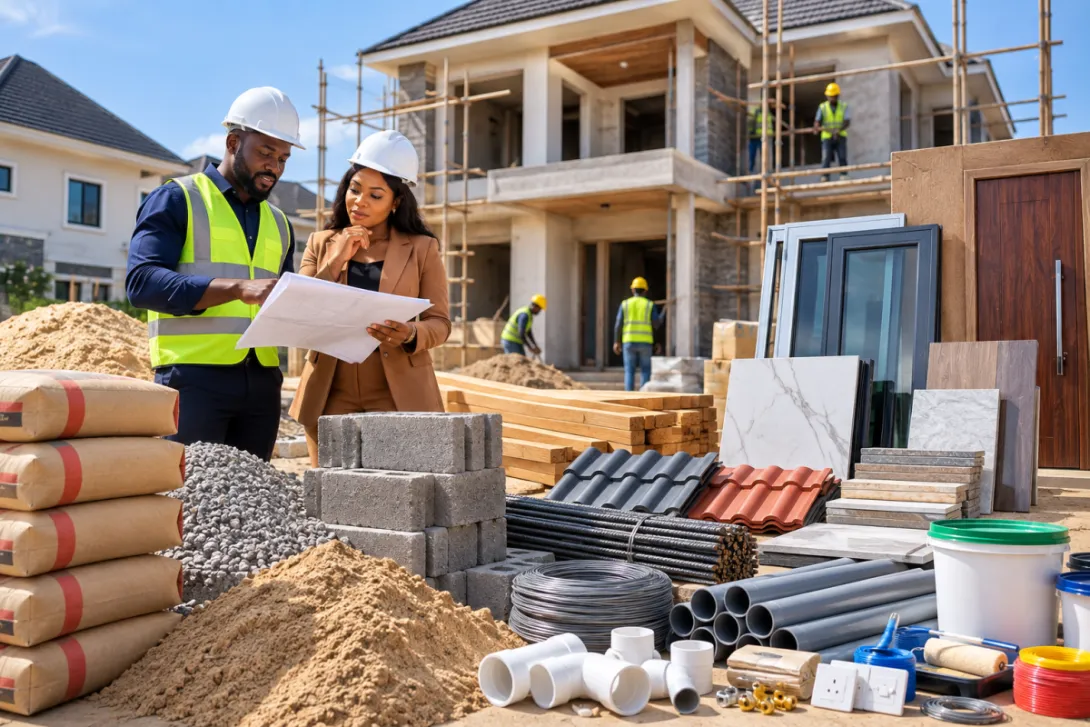
Building a home is one of the biggest financial commitments many people will make. Yet, surprisingly, many homeowners know the price of a bag of cement or a truckload of sand without really understanding the role those materials play in the construction of the building.
That knowledge gap can become expensive.
Choosing the wrong material, accepting poor-quality products, buying materials in the wrong quantities or allowing materials to be substituted without proper professional approval can affect the strength, durability, appearance and long-term maintenance cost of a property.
For homeowners in Nigeria, understanding the basic building materials used in residential construction is therefore important—even if you are not personally supervising the construction site.
You do not need to become a quantity surveyor, architect or structural engineer. But you should understand what you are paying for and why the material matters.
Here are some of the most important building materials every homeowner should know.
1. Cement
Cement is one of the most fundamental materials used in construction.
It is used in concrete, mortar, plastering, screeding and several other construction activities. Cement essentially acts as a binding material, helping other components form solid and durable construction elements.
However, buying cement is not simply about looking for the cheapest bag.
The appropriate cement type and specification should be determined according to the construction work and professional design requirements. Storage also matters. Cement that is exposed to moisture can deteriorate and develop lumps, reducing its usefulness.
Homeowners should therefore pay attention to:
- Manufacturer and product specification
- Condition of the bags
- Storage conditions
- Date and batch information where applicable
- Proper mixing and application
- Quantity required according to the project's specifications
Buying large quantities of cement without considering storage can also result in unnecessary wastage.
2. Sand
Sand is another major construction material used in Nigerian building projects.
Different types of sand may be required for different construction activities, including concrete production, blockwork, plastering and filling.
Sharp sand, for example, is commonly used in concrete-related work, while finer sand may be used for plastering and other finishing applications.
The quality of sand matters because contaminants such as excessive clay, silt or organic matter can affect the performance of construction work.
Before purchasing large quantities, homeowners should ask their contractor or relevant professional what type and specification of sand is required for each stage.
The cheapest sand is not necessarily the most economical option if it produces poor-quality work or requires additional material to correct the problem.
3. Granite and Other Aggregates
Granite and other aggregates form an important part of concrete production.
Concrete generally combines cement, water and aggregates in specified proportions. Aggregates provide bulk and contribute significantly to the strength and performance of the concrete.
Aggregates may also be used for foundations, drainage and other construction activities.
The size, cleanliness and suitability of the aggregate should correspond with the intended use and the project's specifications.
This is another area where homeowners should avoid allowing materials to be selected purely on the basis of price.
4. Concrete Blocks
Concrete or sandcrete blocks are among the most visible materials on a Nigerian construction site.
They form walls, partitions and other elements of the building.
Different block sizes and specifications may be used for different applications. For example, external walls and internal partitions may not necessarily require the same specification.
The quality of the blocks is particularly important.
Poorly manufactured blocks can crack, break easily or contribute to problems that become more difficult to identify after plastering.
Homeowners should pay attention to:
- Block dimensions
- Strength and quality
- Proper curing
- Manufacturing consistency
- Cracks and visible defects
- Whether the blocks meet the project's specification
A cheaper block can become expensive if it leads to excessive breakage and material wastage.
5. Reinforcement Steel
Reinforcement bars, commonly called iron rods or rebar, are critical to reinforced concrete construction.
They are incorporated into structural elements such as foundations, columns, beams and slabs.
Concrete performs very well under compression, while steel reinforcement provides important tensile capacity. Together, properly designed reinforced concrete elements can provide the structural performance required by the building design.
This is one material homeowners should never allow to be changed casually.
The diameter, grade, quantity, spacing and placement of reinforcement should follow the structural engineer's design.
Using a smaller or inferior reinforcement because it is cheaper can have serious consequences.
The homeowner should therefore ensure that the reinforcement being purchased corresponds with the structural drawings and specifications.
6. Binding Wire
Binding wire may look insignificant compared with cement, blocks or reinforcement bars, but it has an important role on site.
It is used to tie reinforcement bars together before concrete is poured.
The purpose is to help maintain the intended reinforcement arrangement during construction.
Because it is relatively inexpensive, homeowners may overlook it when preparing budgets. But construction budgets should account for all the materials required to complete each stage properly.
7. Timber and Formwork Materials
Timber and other formwork materials are commonly used to create temporary moulds that hold fresh concrete in the required shape until it gains sufficient strength.
They may be used for beams, columns, slabs and other structural elements.
The quality and stability of formwork are important because poorly constructed formwork can result in:
- Incorrect dimensions
- Concrete leakage
- Poor finishes
- Structural defects
- Delays
- Material wastage
Formwork should therefore be designed and installed properly rather than treated as an insignificant temporary component.
8. Roofing Materials
A roof protects the building from rain, sunlight, wind and other environmental conditions.
Common roofing options in Nigeria include aluminium roofing sheets, long-span sheets, stone-coated roofing products and tiles, depending on the design and budget.
But roofing is more than the visible sheet.
A complete roofing system can involve:
- Roofing sheets or tiles
- Timber or steel framework
- Fasteners
- Ridge caps
- Flashings
- Gutters
- Insulation where specified
- Waterproofing components
- Other accessories
Choosing a roofing material should therefore involve considering durability, weather conditions, maintenance requirements, appearance, installation and total cost.
For coastal environments, for example, corrosion resistance may deserve particular attention.
9. Doors and Windows
Doors and windows contribute to security, ventilation, natural lighting, energy efficiency and the overall appearance of a property.
Depending on the design, homeowners may choose aluminium, steel, timber, uPVC, glass and other combinations.
The quality of the frame, glass, locks, hinges and installation all matter.
A beautiful window with poor installation can still result in water leakage, drafts, security problems or premature deterioration.
Homeowners should therefore consider the complete installation rather than simply comparing the price of the window itself.
10. Electrical Materials
A modern home requires a properly planned electrical system.
Electrical materials can include:
- Cables and wires
- Conduits
- Switches
- Sockets
- Distribution boards
- Circuit breakers
- Light fittings
- Junction boxes
- Earthing components
- Other protective equipment
Electrical materials should be selected according to the electrical design and the expected load of the building.
This is not an area where homeowners should simply purchase whatever looks affordable.
Using inappropriate cables, protective devices or fittings can create safety risks and future maintenance problems.
Electrical installation should be carried out by competent professionals and should comply with applicable requirements.
11. Plumbing Materials
Plumbing is another part of construction that homeowners sometimes overlook until problems appear.
Plumbing materials may include:
- Water supply pipes
- Waste pipes
- Drainage pipes
- Valves
- Fittings
- Water tanks
- Pumps
- Traps
- Sanitary fittings
- Drainage accessories
Poor-quality plumbing materials or improper installation can lead to leaks, blocked drainage, dampness and expensive repairs.
Since much of the plumbing system eventually becomes concealed behind walls, floors and ceilings, getting it right during construction is particularly important.
Repairing a concealed pipe after the building has been completed can be considerably more disruptive than installing it correctly in the first place.
12. Tiles and Flooring Materials
Tiles are not only decorative. They also affect durability, maintenance and the functionality of different spaces.
Homeowners may use different flooring materials for living rooms, bedrooms, kitchens, bathrooms, balconies and outdoor areas.
When selecting tiles, consider:
- Durability
- Slip resistance
- Water exposure
- Maintenance
- Size
- Installation requirements
- Availability of replacement tiles
A tile that looks attractive in a showroom may not necessarily be appropriate for every part of a home.
Bathrooms and outdoor areas, for example, require careful consideration of slip resistance and water exposure.
13. Ceiling Materials
Ceiling materials help create the finished appearance of a home while also providing opportunities for lighting, ventilation and concealing certain services.
Depending on the design, homeowners may encounter POP, gypsum boards, PVC ceiling materials and other systems.
The choice should take into account:
- Durability
- Moisture exposure
- Maintenance
- Design
- Installation requirements
- Fire and safety considerations where applicable
The right ceiling system depends on the particular room and building design.
14. Paint and Finishing Materials
Paint is one of the final materials people notice, but it is more than a colour choice.
A good finishing system may involve preparation, primers, undercoats, appropriate paint products and proper application.
The surface being painted also matters.
If plastering is poorly executed or moisture problems are ignored, even expensive paint may eventually peel, stain or deteriorate.
Homeowners should therefore avoid treating painting as a cosmetic exercise alone.
15. Waterproofing Materials
Water is one of the biggest enemies of buildings.
Waterproofing may be required in areas such as:
- Foundations
- Basements where applicable
- Bathrooms
- Roofs
- Balconies
- Terraces
- Wet areas
- External walls exposed to significant moisture
The appropriate waterproofing system depends on the specific problem and construction detail.
Waterproofing should ideally be considered during design and construction rather than only after dampness has appeared.
Why Homeowners Should Understand Building Materials
You may ask:
“If I have an architect, engineer and contractor, why should I know about building materials?”
Because you are ultimately responsible for the investment.
Understanding the basics helps you ask better questions.
For example:
Instead of:
“Why do we need this much steel?”
You can ask:
“Does this quantity correspond with the structural engineer's reinforcement schedule?”
Instead of:
“Can we use this cheaper material?”
You can ask:
“Does this alternative meet the specification and has the relevant professional approved the substitution?”
That difference is important.
Do Not Choose Building Materials Based on Price Alone
Construction costs in Nigeria can change significantly because of factors such as material prices, transportation, exchange rates, location, labour and market conditions. Recent 2026 construction estimates also show that major expenses extend well beyond cement and blocks to include roofing, doors and windows, electrical and plumbing work, tiling, ceilings, painting and fittings.
The cheapest material may reduce your immediate expenditure but increase your long-term cost through repairs, replacement or premature deterioration.
At the same time, the most expensive material is not automatically the best choice.
The objective should be to select appropriate, properly specified and quality materials for the intended purpose.
How Homeowners Can Reduce Material Waste
Good material management can make a significant difference to the cost of construction.
Homeowners should consider:
1. Have a Proper Bill of Quantities
A properly prepared Bill of Quantities can help establish what materials are required and in what quantities.
2. Buy According to the Construction Schedule
Do not automatically purchase every material at the beginning of the project.
Some materials require secure storage, while others may deteriorate when exposed to weather or moisture.
3. Use Reputable Suppliers
Buy from established suppliers and verify the quality and specifications of materials before accepting delivery.
4. Inspect Deliveries
Do not assume that everything delivered to your site is exactly what was ordered.
Check quantities, sizes, specifications and visible condition.
5. Keep Records
Maintain records of purchases, invoices, deliveries and material usage.
This can make it easier to identify unusual consumption or unexplained shortages.
6. Do Not Permit Unapproved Substitutions
If a contractor proposes changing a material, ask why.
The substitution should be assessed by the appropriate professional to determine whether it is technically suitable.
The Homeowner's Most Important Building Material Is Good Information
A homeowner does not need to personally supervise every bag of cement or every reinforcement bar.
What matters is having the right professionals, proper drawings and specifications, realistic budgeting, reliable suppliers and adequate supervision.
Building materials are only effective when they are correctly selected, properly stored and properly installed.
The quality of the final building therefore depends on more than how much money was spent.
It depends on what was purchased, whether it was suitable, how it was used and whether the construction was properly executed.
Before you begin construction, take the time to understand the major materials your project will require. Ask questions. Review specifications. Keep proper records. And do not make structural or technical substitutions simply because another material appears cheaper.
A home is too significant an investment to build based on guesswork.
Final Thoughts
From cement and sand to reinforcement steel, blocks, roofing, electrical materials, plumbing systems and finishes, every building material has a role to play.
The goal should not simply be to buy expensive materials. It should be to use the right materials, at the right specification, in the right quantity and at the right stage of construction.
For homeowners, that knowledge can help prevent waste, control costs and contribute to a home that remains safe, functional and valuable for years to come.
LandMall doesn’t just help you find the right property. Through our partnership with Brick Fort, we can also help turn your property into a quality, well-planned home.
Find your land. Build with confidence. Build with LandMall & Brick Fort.
Contact us today 📲 +234 901 900 1191