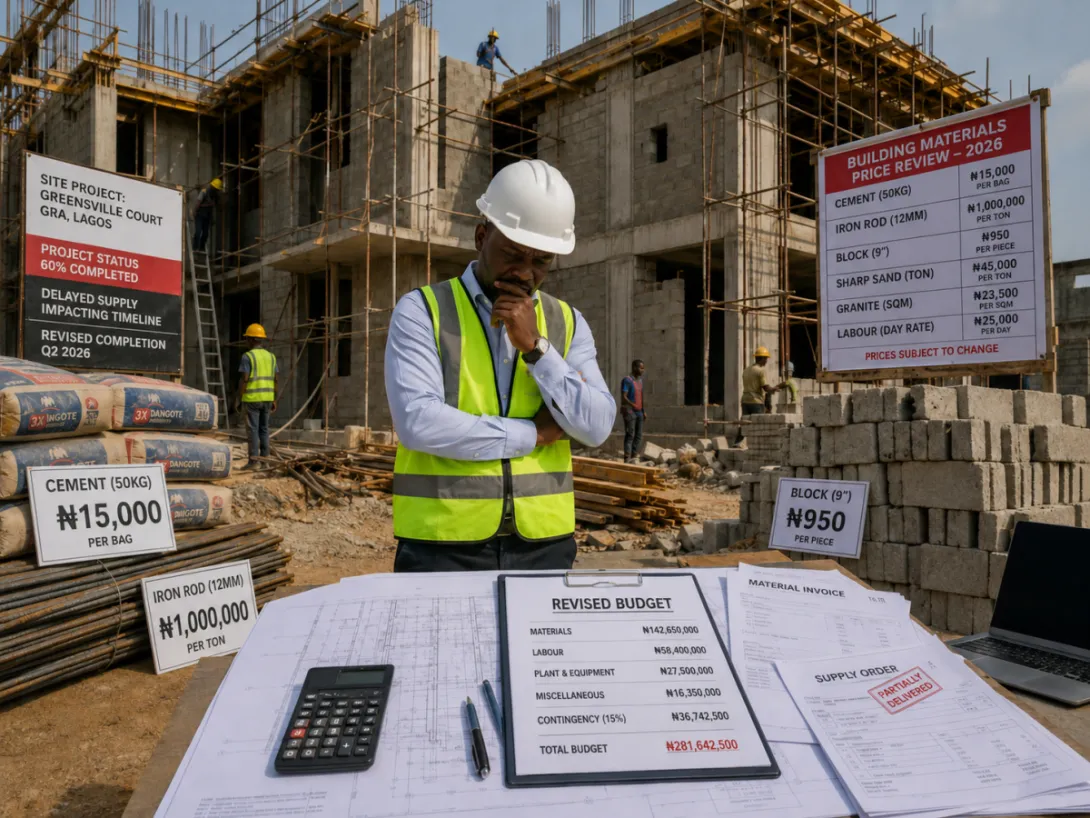
Construction activity in Nigeria in 2026 is still moving, but the market is far more demanding than it was a few years ago. Developers are dealing with a difficult mix of high building costs, tight financing conditions, compliance pressure, land documentation issues, and execution risk. At the same time, demand for housing remains huge. Federal housing data released in January 2026 put Nigeria’s 2025 housing deficit at about 14.93 million units, while the Housing Ministry separately cited 15.2 million units as of 2025.
That combination is what defines construction in Nigeria in 2026. Demand has not disappeared, but delivering viable projects has become harder. The Federal Ministry of Housing and Urban Development has publicly identified persistent sector challenges including limited access to land, high construction costs, weak land documentation, inadequate mortgage financing, and skills gaps.
1. Rising Building Material Costs Are Reshaping Project Budgets
One of the biggest pressures on developers in 2026 is the cost of materials. Recent Nigerian market reporting says rising prices for cement, steel, sand, and wood are slowing real estate development, delaying projects, and making many schemes less viable. BusinessDay reported in March 2026 that a 50kg bag of cement, which sold for about ₦7,500 in late 2025, had climbed to roughly ₦11,500 to ₦15,000 in several locations by early 2026.
This is not just a pricing inconvenience. It changes feasibility. When material prices move sharply during a project, developers either redesign, phase delivery, reduce finishing standards, or delay execution while they rework budgets. Research and sector analysis tied to Nigeria also continue to show that exchange rate volatility, rising material costs, unstable market conditions, and supply constraints are major drivers of price escalation on building projects.
2. Finance Is More Expensive and Harder to Structure
Developers are also operating in a tighter financing environment. Reuters reported in May 2026 that Nigeria is projected to spend about $11.6 billion, nearly half of government revenue, on debt payments in 2026, highlighting how debt costs are crowding out broader development spending. That macro pressure matters for infrastructure delivery, public support, and the general cost of capital environment around real estate and construction.
At the project level, this means developers must be more careful with leverage, presales, and cash flow timing. Even where buyer demand exists, many projects are harder to fund because high input costs and affordability pressure make margins thinner and risk harder to price. This is one reason developers in Nigeria are increasingly forced to build more cautiously, not just more cheaply.
3. Land Documentation and Compliance Risks Are Under More Scrutiny
Another major challenge in property development in Nigeria is compliance. In Lagos, the state government publicly identified 176 illegal estate developments, mostly in Eti Osa, Ajah, Ibeju Lekki, and Epe, and gave developers time to regularise layout approvals. Recent reporting also indicates renewed enforcement against estates operating without approved layout plans and building permits.
For developers, this means land is no longer just about location and price. It is also about whether the title is regular, the layout is approved, and the development path is clean. The Housing Ministry has explicitly said secure land documentation, registration, digitisation, and verifiability are critical because land only becomes a true asset when it is properly titled and documented.
4. The Housing Need Is Huge, but Affordability Is Weak
Developers are building into a country with enormous housing need, but that does not automatically translate into easy sales. The official housing deficit remains extremely large, yet the affordability side is under pressure from high construction costs, expensive land, and weak housing finance. The Federal Ministry has said that solving the housing gap requires stronger land administration, housing supply, infrastructure development, and mortgage finance expansion.
This creates a difficult reality in 2026. Developers know the market needs more housing, but many households cannot absorb the final selling price that today’s construction costs produce. So the challenge is no longer only how to build. It is how to build at a price the target market can realistically carry.
5. Skills Gaps and Labour Quality Still Affect Delivery
Execution on site remains another challenge. The Housing Ministry’s January 2026 policy messaging included skills gaps among the persistent issues affecting housing delivery. Newer Nigeria focused research from 2026 also points to labour shortages and productivity problems in the construction sector.
For developers, the practical meaning is clear. Even when funding and materials are available, the quality and availability of skilled artisans, supervisors, and project teams can still affect timelines, workmanship, and rework costs. In a market where inputs are already expensive, poor execution has become even more dangerous because every correction costs more than it used to.
6. Developers Are Under Pressure to Localise Inputs
The push toward local materials is not just policy language anymore. It is becoming a real market necessity. Federal housing officials have repeatedly argued that Nigeria needs to reduce reliance on imports, expand local building material production, and make construction more affordable. In 2025 and 2026, the government promoted local building materials and building materials manufacturing hubs as part of its housing strategy.
This matters because imported content, directly or indirectly, exposes projects to exchange rate movement and supply chain shocks. Developers who depend too heavily on imported finishes or systems face more volatility in pricing and procurement. The market is increasingly rewarding teams that can redesign intelligently around available local alternatives without losing too much quality.
7. Planning, Phasing, and Feasibility Matter More Than Before
In a softer market, weak planning can sometimes be hidden. In the 2026 Nigerian market, it is exposed quickly. Developers need stronger feasibility work because cost assumptions can go stale fast, approvals can affect timelines, and affordability constraints can change product strategy. The ministry’s current policy language around housing delivery and sustainable cities also emphasizes effective land management, urban renewal, local materials, and public private partnerships, all of which point to a more disciplined development environment.
That is why many developers are now phasing projects, simplifying scope, adjusting unit mix, or delaying non essential upgrades. The challenge is no longer just constructing a building. It is structuring a project that can survive cost pressure, compliance risk, and slower end user absorption.
What This Means for Developers in 2026
The current Nigerian construction market is not impossible, but it is unforgiving. Developers who still rely on old assumptions about land, approvals, materials, or buyer affordability are more likely to struggle. The ones with better chances are those who verify land thoroughly, plan harder, control procurement, manage quality tightly, and adapt product strategy to current market realities.
In simple terms, the biggest challenges developers are facing in Nigeria in 2026 are these: higher building costs, financing pressure, compliance enforcement, land documentation issues, skills gaps, and the difficulty of delivering housing that the market can actually afford. Those are the realities shaping real estate development in Nigeria right now.
Final Thoughts
Construction in Nigeria in 2026 is still full of opportunity, but only for developers who are realistic about the market. The opportunity is real because the housing need is real. But the pressure is also real, and success now depends far more on discipline, verification, cost control, and strategy than on optimism alone.
Developers who understand today’s market will not just ask whether a project can be built. They will ask whether the land is clean, whether approvals are secure, whether the cost plan can hold, whether the team can execute, and whether the final product matches actual demand. That is the mindset the 2026 market requires.
Planning a development project in today’s market requires more than ambition. It requires structure.
LandMall helps investors and developers access better property opportunities, while Brick Fort, LandMall’s trusted partner, supports clients with practical guidance across planning, development, and project execution.
Call or WhatsApp +234 901 900 1191 or +234 808 668 2070 to get started.